
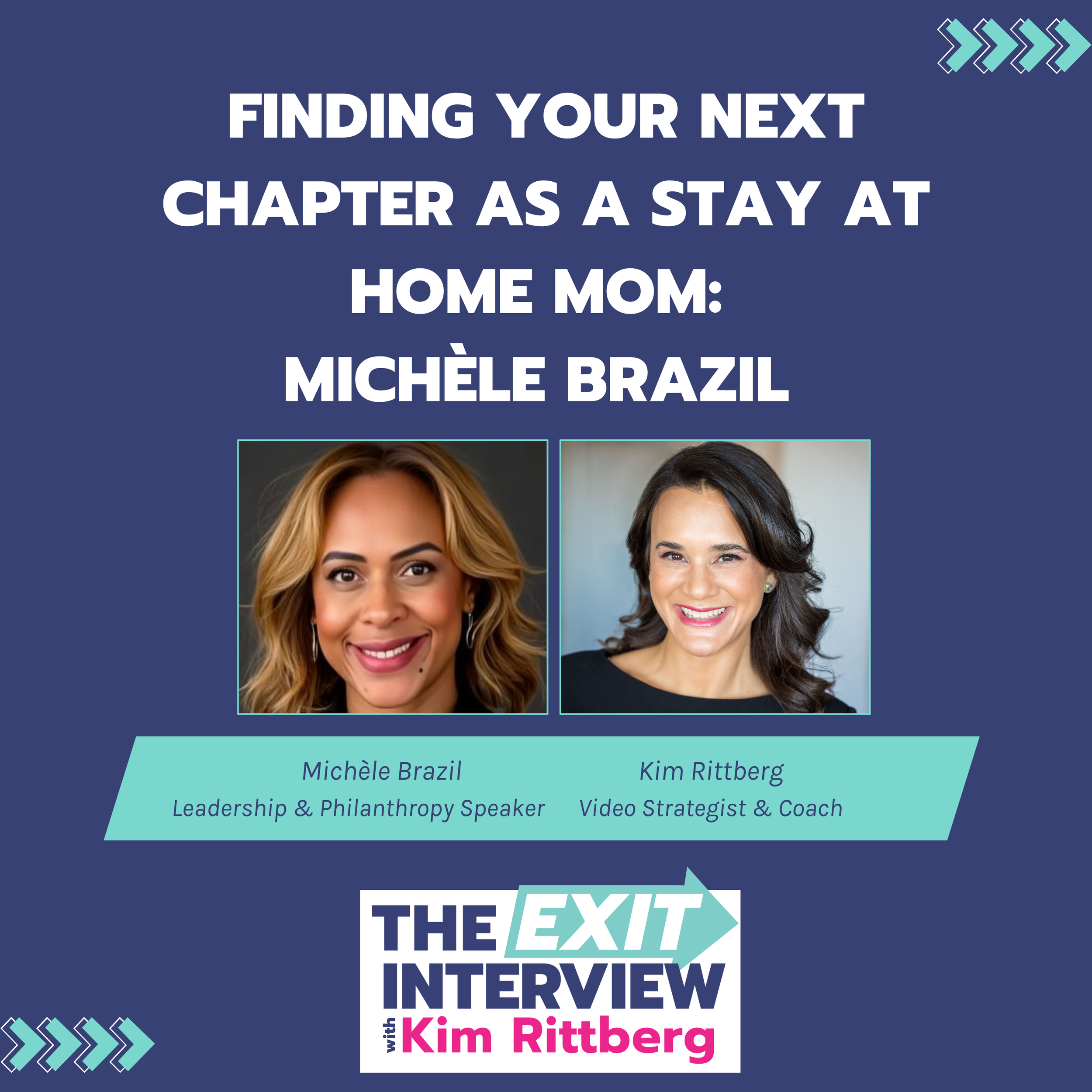
Ep. 171 /Finding Your Next Chapter As A Stay At Home Mom: Michèle Brazil
SHOW NOTES:
Please leave a rating and review for the show!
++++++++++++++++++
Michele Brazil spent 15 years producing content for powerhouse outlets like Oprah Winfrey Show, HBO Real Sports, and Sundance Channel before stepping away from her career to raise her children.
While motherhood brought deep fulfillment, Michelle eventually faced a question many women experience during major life transitions: Who am I without my job title?
After feeling reduced to “just a stay-at-home mom” in social settings, Michelle began searching for a way to reconnect with her identity, skills, and passions.
That search led her to volunteer work with the Fiver Children’s Foundation, where she rediscovered her leadership abilities and confronted imposter syndrome head-on. Through her involvement, Michele realized that motherhood had actually strengthened many of her professional skills—organization, negotiation, leadership, and emotional intelligence.
Today, Michele empowers women to reclaim their confidence, speak up in rooms where they once felt invisible, and redefine success on their own terms.
You will learn:
How to navigate identity shifts during major life transition
Why many high achievers struggle with imposter syndrome
The powerful leadership skills developed through motherhood
How volunteering can help you rediscover purpose and confidence
Why celebrating small wins is essential for personal growth
Did you love today’s episode?
1. Take a screenshot and share it to your IG stories. Tag me @kimrittberg
2. Leave us a rating and review on Apple Podcasts!
LISTEN BELOW! And don’t forget to ‘follow’ and leave a rating & review!
Click below to Follow, Review & Give a 5-star rating to Kim’s Exit Interview Podcast.
TRANSCRIPT:
(00:02) Michele Brazil spent 15 years producing content for powerhouse outlets like the Oprah Winfrey Show, HBO's Real Sports, and the Sundance Channel before stepping away to raise her children. But answering, "What do you do?" with, "I'm home with the kids," left her feeling invisible. A shift that sparked a personal reckoning.
(00:19) Realizing how much of her identity had been tied to external validation, Michele began redefining success on her own terms. She started running competitive races, joined the board of directors for the Fiverr Children's Foundation, and found new confidence by leading with authenticity. Today, Michele is a sought-after speaker and facilitator who helps moms in transition reclaim their sense of self and chart their next chapter with courage.
(00:42) Through keynotes and workshops like Crushing Self-doubt and Commanding the Room, she draws on her media background, motherhood journey, and board leadership to empower women to speak up, take action, and rebuild self-worth in any room. Her mission is to help women reclaim their confidence and recognize that the validation they're seeking is already within them.
(01:01) Michele, I'm so excited to have you here. >> Tim, I'm thrilled to be here with you. >> So, one of the things that I love that you talk about is this kind of identity crisis. So many of us have had it in different ways at different places, whether you're a stay-at-home mom or you're working full-time or you're in between.
(01:20) Like there's so many times where we're in transition and we're thinking about who am I? What am I doing? Is this fitting me anymore? So take me back to that moment where you realized, okay, I'm with my kids. I'm happy. This is good. And actually something shifting. I'm realizing I want to do something else. Something out else is out there for me.
(01:40) Talk to me about that. Like when did that moment happen? How did that happen? Well, you know, like you said in your intro, going to cocktail parties with my husband is an attorney, you know, we would be out with these you high - achieving people and I would be asked, "What do you do?" I'd say, "I stay at home.
(02:00) " And then, you know, the eyes just glazed over and it was like, "Okay, I guess you do nothing." But what really was the moment for me was my husband had a new assistant and I called the office and I said,"Well, I'm really looking forward to meeting you." And she said, "I can't wait to meet you. I've heard so much about you.
(02:19) " I said, "Oh, really?" And she said, "Yeah, you know, everyone says Michele's had three kids and she looks so good still." And all I thought was, "Oh my god, have I just been reduced to like this arm candy? Like, is that it? I've got so much going on other than the children, but I'm a thinking person. So, that kind of got me down.
(02:40) But also thinking about what can I do for myself that kind of proves that I'm more than just I like to say like the show pony at the cocktail party and the mom, you know, chasing kids around. So that kind of got me thinking like what can I do that one is flexible in my schedule for my kids, two that isn't just like too involved.
(03:05) Um so I started looking into volunteering really. That's how that started. >> And so I want to step back a little bit. So talk to me about deciding to be home with the kids. Was that you know where tell us about where you went to college like what did you worked in media for a little bit? Did you struggle with the idea of being home with your kids or you were like I always knew I wanted to do this? Like there was no there was no conflict.
(03:27) >> Oh yeah. Well, you know, I always knew I wanted to be a mother and be home with the kids. My mother was home with us, so it was always nice to get, you know, come back from school or just have someone there. Um, drives to the movies, all that kind of stuff. But, um, yeah, I went to Wellesley College and, you know, all women's college.
(03:51) Um, and it's funny because when I was applying to school, I had kind of always wanted to go to Wellesley because I'd always heard that the women who went to Wellesley were the ones who were, you know, leading the leaders of the world in different industries. Um, and when I was applying, it was Bill Clinton's first campaign for his uh first term.
(04:11) So, you know, that's when the world was introduced to Hillary, who was a Wellesley Grad. So, I was just I want to be that, right? Um, so going to Wellesley, which was great. It was, you know, just as competitive competitive as a co-ed school. Um, I also have two brothers, so and I went to a small independent school where at the time I will say was very much about boys, academics, athletics, everything.
(04:37) So Wellesley was the environment where I saw, wow, like women can really do this stuff. they can be just as um athletic, just as intense and competitive in the classroom. Um, so I definitely feel like I needed that to give me that boost of, you know, I am woman, hear me roar maybe. But, um, that was the thing.
(05:02) It was just like you were very much driven. You weren't told that there wasn't anything you could not do. Anything was possible. So, um, I graduated. I worked in TV and I realized very early that it was up to me to really get to the next rung on that ladder. So, um it was very much about making relationships, not burning bridges, going from one job to another, maybe working at corporate.
(05:32) My last projects were all my last few years in the business were all freelance and it was really finding teams that I worked really well with and getting, you know, the leads and putting myself out there and it was fun and thrilling, but there was so much travel in it that it wasn't going to work for, you know, having children, having a family.
(05:53) So, I mean, we did have some trouble creating our family that we had always talked about. Um, I mean, this is something else women never talk about or hadn't before, right? Was the problems um of carrying children. You always hear you get you got to get through the first trimester. Well, I did. I got through the first trimester.
(06:14) I got through half of the second and I had losses. I had two pregnancy losses within 10 months. So, one at six months and one at like five months on the dot. So I threw all from after the second loss, I really threw all of my attention and you know thankfully my husband was totally supportive in this but I started advocating for myself and my health and really finding doctors who would listen um because the protocol was just wasn't I would say patient or woman friendly um for me in my journey but that definitely gave me strength and we were able to
(06:57) have three healthy babies that I carried full term. Um, and so I think throwing myself into that family planning and making sure the kids were all right was my sole focus for so many years. So when the opportunity came, I guess it was like my daughter, my youngest had to be about a year, a year and a half when um my husband's assistant relegated me to just I guess just losing all the weight for pregnancy and looking good.
(07:30) So I felt at that time there was a little bit of space in my schedule to be able to do something. Um yeah, I hope I answered your question. >> Yeah. Right. Right. So So Right. So you when your littlest was one and your oldest was how old? >> Uh she was about five or six. >> So everyone was in preschool for the most part. The older two. Yeah.
(07:52) >> Got it. >> When you started getting involved with your charity work and running and running a race and Yeah. And then you and and you had said there was a time where you called your husband's office and tell me about what the assistant said. >> Oh gosh. >> So yeah. So, she had said, "Well, I hear, you know, everyone says Michele had three kids and she still looks so good.
(08:15) " So, I was thinking, I was like, I've known a lot of these people since we were dating and here we are many, many years later and all I'm regulated to is someone who lost the baby weight and has kept the baby weight off. you know, not all the other projects that I was talking about at those dinner parties and cocktail parties before, you know, we had kids.
(08:40) It was just Michele still looks good. >> And I was like, this isn't my work for me. >> And that was kind of light bulb where you're like, Michele is so many more things than just like a beautiful woman on the arm of someone. >> Yes. Exactly. Exactly. Yeah. That was that did not sit right for me at all. >> Yeah.
(08:59) And then so what one thing I love because I I've talked to so many women, so many moms on this show about like we all have so many internal struggles. Like I know personally when I left media basically I had like a few jobs that were not fits. I had already decided like when I was working in media I had had my second child and I was working during delivery.
(09:22) I was like, "Oh my god, I don't like anything this much that I want to be working during my labor." And I had that moment of like, "Oh, I want to do some of this, but in some different way." So, I didn't I didn't I knew I didn't want a full-time role, but like what does that look like? I don't know. >> And I had such an identity crisis.
(09:39) I remember really thinking, "Okay, if I don't have a business card that says media.com, like at netflix.com, at UsWeekly.com, who's going to want to invite me to a party? who's going to talk to me? And I realized how messed up that was because it took me a long time to realize that. But >> I realized over time that those jobs are just bullets on my resume, right? They're just bullets on my resume. They are not my identity.
(10:06) But it was really hard to figure out what that looked like. How do I >> To me it was really important to be able to like pick my kids up from school at least sometimes. If not every single day, at least sometimes. And it took me a a while to figure out what is this new structure going to look like? But prioritizing to your point, my priority was saying I want to structure my life in a way where I could see my kids.
(10:28) I'd been traveling a lot. The hours are long. Like I just, you know, basically, you know, up in the morning and then back at night and I just wanted more time with my kids. So anyway, the identity crisis piece, I think I've talked to so many women and they have that moment where they're like, "Do I work full-time? Do I stay home with the kids? Do I do something in between? How do I find joy and passion and value inside myself? So, I would love for you to share a little bit of that of how you found um more meaning like I think you were
(11:01) looking for more more meaning, more drive like you wanted to sort of find something outside what you had been doing. So, talk to me a little bit about how you found that, how you pushed forward, what you decided you wanted to be doing in this next stage. Well, you know, it's funny because there was a lot that was driving it, right? It was I wanted more for myself, but it was also kind of like being driven by that judgment that I was feeling, you know, also not just the cocktail parties, but like going back to a college reunion,
(11:34) you know, and it was, you know, people are, I don't know, at that point maybe they were like residents or become attending the hospitals or, you know, their their legal career was going and they're, you know, they're powerhouse. houses and I'd be there as like, "Oh yeah, I've been home with the kids," you know, kind of thing.
(11:55) So, it was just I was I was driven by myself and also the judgment. So, what I did was I had to figure out what it was I liked. I had this I didn't have a lot of time to give, but I realized that if I was going to give my time, it had to be something that I enjoyed doing. So, I joined a board. It was Fiver Children’s Foundation board.
(12:18) And I remember going to board meetings and at the time the board was I would probably say 80% male and most of them were finance or law and um here I am like ah I stay at home with the kids right so >> you have like you have like milk on your shoulder and you have like a dirty diaper out your pocket you're like hey everybody what's up >> right and it's like you're introduced and they're like oh Okay. Right.
(12:46) You know, all right. So, what I realized was I just started becoming a very active board member and um I was helping with their productions for like, you know, the video clips at benefits and everything. So, I was exercising those muscles and also being able to like call my network and it was really great because people were still there and they're like, "Oh.
(13:13) " Um, but I also realized I was totally overcompensating because my title was, you know, stay-at-home mom for all intents and purposes, right? But in that overcompensating, I was learning so much about the organization and able to um speak to donors and do just do a lot and work with the staff on different strategies and things like that.
(13:41) And then before I knew it, I was, you know, chairing a committee. And then I became vice chair and I was just like, "Oh, they're just giving this to me because they think I've got all this time on my hands." And I remember my husband said to me, he goes, "Why are you thinking about it like this? Maybe they just think you're good at what you do.
(14:00) " And I was just like, "Oh, I hadn't thought about it." But I was like, it was all that self-doubt, you know? However, I was performing and I was executing and I was getting results. But in all of that, I was just, you know, had this voice in my ear just just like, well, you have to do this because everybody else has a full-time job, you know, not really realizing that my children are my full-time job.
(14:26) But it really helped me because I was doing stuff that I enjoyed, you know, and um when I did sit back and look, I was just like, "Oh, wait a second. I actually have been doing a lot, you know, and I'm using these skills that I, you know, had attained through all my jobs, but also through being a mom, like juggling all those things.
(14:50) always love to say that, you know, I worked in production and logistics and this and that, but then when I became a mom, it was the birthday parties became my productions. >> Yeah. >> The vacations became my productions. So, it was just like I was actually doing the same thing. I mean, on a smaller scale, but still using all that I had learned, you know, in all my jobs.
(15:13) And one thing I think is helpful for women and in general everyone to remember is life is cumulative. You worked in media for over 10 years, right? You you have all of these skills. I worked in media. I know a lot of the things that you did. You know, you connected with talent. You organize things.
(15:29) You troubleshoot when things are going down. You're traveling. You're really working on the fly. It's hard. It's grueling. You have a lot of skills from that era. And I think we often forget, oh well, I did that way back when, so whatever. No, that's still something that you did. You earned that. You have those skills.
(15:46) Maybe they're rusty. So what? Um, and it's funny what you were saying about birthday parties. My friend said to me, you know, it's it's funny because I really don't like planning vacations now. They're like, I would think that you like planning vacations. I say, I used to like planning vacations, but now now that I've worked in TV and media and I'm running my own business and juggling a hundred balls and I'm also >> chief operating officer of our house, I don't want to plan the vacation.
(16:11) I don't want to plan the vacation. I will find a few things that are really fun that I want to do, but I don't want to book the hotels. I don't want to book the flights. They're like, "Huh?" I'm like, "Yeah, I don't I don't want to do that part." Like that. My husband can do that. But I think it's it's it's, you know, I think it's it's so true.
(16:25) Like planning parties, planning trip, planning birthday parties, planning trips, it's all the same as TV production. They are real skills. They're hard. You're juggling a lot of things. It's a budget. It's it's it's it's delegating. It's making sure everyone's coming on time. So anyway, that was an aside, but I would love to hear from you.
(16:41) You have so much great advice that you've gleaned from your experience. Tell me a little bit about when you showed up at this charity and you joined the board, it sounds like you had real impostor syndrome. So many women feel this. What would you advise other women as they step into a moment and they're feeling that impostor syndrome? What should they think about? What's your advice for them? >> Well, you know, it's funny.
(17:03) It was one of the reasons why I joined the board. So, it's a youth development um organization and we catered to kids from 8 to 18 and sometimes beyond. And one of the things that I wanted to um just make sure and you know be an example for the kids was that if you're in the room, you belong in the room because you made it into the room and there's a reason why you're there.
(17:33) And in my interview process with some board members, it was really funny because there was a board member who was interviewing me and like he's this highpowered attorney and he's just like well he's just like everyone feels that. He's like I feel that. And I was just like oh interesting. So you're not alone when you're walking in the room thinking you don't belong.
(17:55) And all those people who you were looking at there who maybe seem really comfortable and they're laughing and they've got a big title or something, something in their head is telling them, "I don't know if I should be here. I don't know if I have anything to give or to help make an impact." But everyone's feeling that way.
(18:15) So, you should just know that once you walk into the room, you are surrounded by people who are feeling the same way. And you kind of just got to be the first one to speak, you know. And once I realized that, I have to say because I do consider myself an introvert. But there was a moment when I was, you know, probably after my second year on the board, I realized you just got to go. You just got to talk.
(18:40) You just got to speak. You know what I mean? And I remember it was I always admired my husband so much for this. Like we'd walk into a room and he would just walk up to someone be like, "Hi, I'm Joseph." How does he do that? I'm like, "Oh my god, he just went up there and said, "Hi, I'm Joseph." I was like, "I could never.
(18:57) " But you know what? Now I do because you're just breaking the ice. And going to talk to someone and introducing yourself to them, you almost see the relief on their face when you do that, you know? So, you just have to pretty much figure everybody's feeling the same way. I love that. >> I love that.
(19:18) And I love the honesty of like tapping into yourself and saying, "Yes, okay. I I feel unworthy or or like a fraud or like imposter syndrome." Like I have over the past few years become a speaker. When I first wanted to speak, I was too nervous to even like say I wanted to speak. Like I told my brother, he was the only person I told.
(19:39) And I had already had this like really great media career. So, I knew I had expertise, but I didn't have the like confidence that I was going to like be on a stage and have people listen to me. But I did want it and I started working for it. And my very first keynote, like people see the photos from it, I thought I was going to throw up and black out.
(19:59) >> The five seconds before I went on stage, they said my name and I was like, I'm gonna faint. And I thought, I'm not going to faint. I practiced so much for this speech. I'm not going to faint. And I just like sweated my brains out and went right up on that stage and and just did it.
(20:16) But I think people forget like they asked me about speaking and I'm like I practiced so much that truly I I I there was no way I was going to black out. But I was so nervous. I had such imposter syndrome. I remember flying back that month. I did two my first keynotes ever in the same month. And I got on the plane and I just started crying.
(20:36) Like such a sense of relief and I was like actually also to your point of like owning that moment. Like I was like, Kim, I'm proud of me. Like this was really hard. >> I did it. Yeah. >> And so I think it's whether you're taking on this leadership role and feeling like less than, you know, with the people in the suits next to you or or you're on a stage or you're just getting out of your comfort zone, it's important to say I did something.
(20:57) It was hard. Give yourself a pat on the back. Like I think that's also, you know, we talk about high achievement culture, you and I, we talk about high achievement culture, and it's great to keep trying for the next thing, the next thing, but it's also more important, just as important to say, I did this thing, whatever it is.
(21:16) I I I put myself in a new situation. I I joined a a new charity. I volunteered. I I started a side hustle. Whatever that thing is, but saying like, >> it's really easy to stay doing what you're doing. It's hard to do something new. So giving yourself credit and saying this is important. Let's cheer myself on.
(21:34) And so I like that piece also and and you being honest and saying I didn't feel great when I first sat there, but then I realized we all were nervous. And it's so true. >> Yeah. Well, that's the thing, you know, with the high achievement. It's like it's so easy to just gloss over things because you're just looking at the next, right? It's like you're always chasing that A or trying to make the team.
(21:54) And then when you actually get that A or you make the team, it's about, okay, what am I going to get on the next test or am I going to score a goal on, you know, in the next game or something, you're not really slowing down and giving yourself one, grace, and two, giving yourself the acknowledgement that you did something hard and you worked hard for it and you made it happen, you know.
(22:17) But I think that's like we get caught up in that >> where you know because you have an idea of what this success looks like >> but you're not even looking at your success you know you're not even giving yourself that time to sit back reflect all the hard work that you did right to memorize that keynote to just get on the plane and get yourself there.
(22:41) >> Totally. And you know, I think if we actually slow down and do that, we'd feel so much better about ourselves. >> Totally. >> You know, >> I um I also have two brothers and my dad was an immigrant and I feel like all we saw was the workhorse side and we are all workhhorses and my middle brother is like >> really I think he would agree with this hard on himself.
(23:02) Like he'll be like, "Yeah, I did this thing. Cool. On to the next." >> And I say, "Let's like let's celebrate this." and he's gotten better at it, but I'm trying to get better at it as well because it's important for all of us, whether you're in New York City or another big city or really anywhere. Definitely in America, >> we feel this like high achievement, high performing, like do the best, be the best.
(23:24) And like doing something new that's hard that you invested in, that you challenged yourself, no matter what it is, we should celebrate it. You know, my husband did a half marathon last year. Well, we both did. It was so hard. I'll never do one again, but um >> Never. I did it last year, too. Never. I did one before I did one before I had my kids. I did one before I had my kids.
(23:42) Very different experience. Totally lovely. Last year I did it. My kids are 10 and eight. I came home. I'm like I'm proud of myself and I never want to do that again. But my husband, but I was super proud of my husband because he's really like not a runner. Like I am definitely like the more active athletic person in the family. And he really crushed it.
(24:03) Like I was so impressed with him and I'm like you should be so proud of yourself. You did great. You look great. You look very healthy. I'm dead. I'm like dead. Um, but anyway, >> I think that it is important for all of us to sort of pause and say, I did something hard and it doesn't matter what that thing is, you know, but I did something hard.
(24:21) I'm proud of myself for stepping out of my comfort zone. And when I teach in video boot camp, which you've done with me, I tell everyone at the beginning, this is hard. Like I teach people to put themselves out there and to put themselves on video. It is hard. Just because other people are doing it does not mean it's not hard. It's really hard at first.
(24:41) And so you have >> I know it's hard, Kim. >> You know it's hard. >> Michele, you are a video star. You are a video boot camp superstar. And actually, I want to talk about you. One thing I love that you share in a lot of your videos on social media through our video boot camp, which I love your videos.
(24:58) Talk to me a little bit about the messages that you share about the skills you get as a stay-at-home mom. Oh yes. So I mean I I did your video boot camp. I found you on Instagram. A friend had reposted something. I guess she had taken your video boot camp and we started working together and then I had to post.
(25:19) And I was just like, "Oh my god." I'm like, but I'm like, "Michele, come on. It's video boot camp. You have to post." So, working through my messaging and everything because you and my one-on- ones with you have just been so like critical to all of my um video success, but it was um really putting out there all the stuff that moms do and how those skills are transferable to a job.
(25:47) And if you look on anybody's LinkedIn page, it's just like these are all the skills that I have and I'm doing as a mother. So, I've been sharing, you know, things like negotiations when you're talking to kids, whether it's about bedtime, curfew, snacks, that's negotiations. And then you've got the um problem solving with incomplete information because a child can come home and tell you about their day whether they're complaining about a teacher or a friend.
(26:19) You know, you have to act. You have got to manage these things. You have to manage emotions. We are really the I mean for the most part I have to say mothers are a majority of mothers are really like at the epicenter of all emotions that run through the household you know and specifically the time of COVID I think was the most difficult because you're managing your own experience through COVID right so um so you know you're dealing the different teams and so it's just like basically like a CEO you know and what I've been talking about is the value behind all of
(27:03) these uh skills that you are executing as a mother and how you know you're not just sitting around eating bon bons watching soap operas you know what I mean like the stereotypical I don't even know where that idea came from because what stay-at-home mom is ever just in the house You're running around.
(27:24) You're going to the store. You got to buy a mouthguard. You got to go get groceries. You got to do you got to go pick up. You got to take someone to ballet, soccer, lacrosse or whatever. You're not stay There's nothing about staying at home moms that is just staying put in one location, you know.
(27:40) So, it has really my messaging around that has really resonated with a lot of people, which is great. >> And how do you feel? One of the things that I really love and you've been such an example of this is when we sit down and really think about the the messages you want to get across. You've had all these things happening to you internally.
(27:59) You're realizing you're charting a new chapter in your life, right? You're home with the kids. Now you're on a board. You've run all these races and now you're speaking. So the process for you of evolving into this next chapter, how has it helped? Like we've been doing a lot of messaging work and video work. How has our work together helped you enter this new chapter? >> Well, the greatest thing about our work together is that I'm kind it's like refining and reshuffling what it is that I want to you know give back to people and you know make impactful changes and
(28:36) help people that way. So I think talking about it and really getting like whittling it down like for example we were uh talking about you know being a mom and how you know if our child expresses some kind of interest you know we're immediately looking something up to find it out if there's a class about whatever it's just like oh my kid's really into dinosaurs maybe they're not old enough to watch Jurassic Park but I'm gonna find a dinosaur dig or I will create a dinosaur dig in the sandbox at the park. Right? So, I really was
(29:14) thinking about it and we're talking I was just like, well, what about my dinosaur dig? Why aren't women taking that time to figure out what it is that they like and exploring what's out there to, you know, I guess broaden their knowledge about it or broaden their excitement around it. So then, you know, I started thinking, okay, you're looking back at yourself, trying to figure out what it is that you like, what really gets you going, what could make you step out of this role as stay-at-home mom, and then, you know, was thinking about
(29:47) the dinosaur dig and then started thinking about excavation, right? So, you're excavating through all the layers of who you are and really excavating through those layers of mom, that mom role, like what are the skills? What is it that you do that um you know really feels like a job? It is very much a job. It's unpaid.
(30:12) There's no time off, right? But just digging through all those layers of the experience of it all. I mean, being a mom, dealing with different classmates and the mothers and all that stuff, uh administration, that's another skill that you have. again, you're not just sitting at home, >> right? >> And I love that you're you're going out there and you're helping moms figure out their next chapter.
(30:39) Give me your top three tips for how a mom a woman in transition can reclaim her voice and confidence after stepping away from a traditional career. >> Well, first and foremost, you don't want to overwhelm yourself, right? Because I think we get our minds going. It's just like, oh my god, am I going to be looking for a job? Is it going to be full-time job? I don't want a full-time job.
(31:02) So, you start small, right? You don't need a full road map. You just, you know, just got to dip your toe in. So, for example, I joined a board. I love kids. So, it was very much I was looking for like youth development. What can what are the skills that what are my skills that could help an organization? So, I started looking around. Thankfully, a friend of mine had introduced me to Fiver.
(31:28) So, I joined the B the board, but I've got a friend who was always into art and so she signed up for an art class and I'm happy to say like years later now she's in a full-fledged program that she had to apply to. She's got a studio that she goes to. Um, it's so funny because she's like sometimes I'll just be in there and get so lost that I forget that I have children.
(31:51) Um, but her kids thankfully are old enough now that they can like take care of themselves. Um, but you know through doing that you find community and so you find people who enjoy what you're doing and what you're and what you enjoy. So I think it's easier to get you out of the house and get you out of your comfort zone around whatever it is that you're doing because you're around like-minded people.
(32:19) Um, and then through that I think you start to recognize the skills that you have, right? And then you can be like, "Oh, I can actually do this." The best part is when you're just like, "I can do this." And they don't know how to do it, right? I'm just But I'm just the mom, you know? Um but yeah, and I think with each of those steps, >> you gain more confidence >> because one, you stepped outside of your comfort zone.
(32:47) You actually signed up to do something, right? So maybe it's I remember when I had Cameron, my youngest, I think she was like nine months when I did my first 10K and I wasn't because I was like I need to do something. I can't be here all these kids. But um I remember I started in a running group and it felt good to have something apart and outside of everyone.
(33:14) And at first, I mean, I would have never thought that I could run a 10K in under an hour, which I did, but it was just like every time I would go out and run, I'd be like, "This is hard, but I'm doing it. I did it." And so, it was just a matter of keeping it up, you know? So, >> and one of the things that I I like that I I've heard you say, you know, through our work together, I coach people obviously to be confident on camera.
(33:39) And I have my tips on like how do you remind yourself that you're awesome, right? Because we get on camera, we're like, oh. But I tell people like read your own resume. Like read remember moments that you achieved something or felt great about yourself or helped a friend in need or did something like so generous for your community that like someone was like, "Michele, you're so kind.
(33:59) " You're like, "I am kind." you know, but >> remember a moment where you're proud of yourself, someone else, you know, appreciated you. And bring that confidence of like, I can do it. I am worthy. I am valid. I love that. And then you have said, you know, what are your your tips for for remaining confident? You know, like I know that we talked about earlier the impostor syndrome
(34:21) What other confidence tips would you have for women? Well, first and foremost, you are the only person who's walked in your footsteps, who's lived your experience, who has had like that challenging job or that challenging boss that you know you were able to get through or work with. There have been different moments in your life that no one else can say is theirs, you know? So so much of I feel like what fuels me but it does go back to the high achievement thing I have to say it's like you know there are these certain standards right I think there are
(35:01) certain standards and different standards but I'm sure you have met one or two that people really admire so I always feel like you go back to that >> you know it it it means something but more than anything it like it goes back to like giving yourself that grace and knowing you're not alone, you know. Um I feel like like you said, you know, you have those moments where you did something for someone and someone's like, "Oh, you're great.
(35:33) " It goes back to that whole piece where just like just stop, recognize, and just know that you did something right. >> You finished that race or you made a difference in someone's life. Just like the whole idea of like paying it forward, just saying giving someone a compliment and you know they smile. You just made someone's day.
(35:56) >> Yeah. >> And that's huge. You know, it's just little things. I don't think it has to be anything big that has to give you confidence. I think it's just really giving yourself grace and knowing that you got up in the morning, you do what you have to do. Um, and just being kinder to yourself. Honestly, at the end of the day, that's one of the things I always tell people.
(36:20) Just be kind to yourself. Just be kind to yourself. You know, my son will come home and um what happened? Maybe he didn't do well on a quiz or something. And I was just like, "But why are you so angry?" And he's just like, "I'm just so mad at myself." And I was like, "Well, you can't be mad at yourself.
(36:37) " I was like, you just have to know what you did wrong and what you need to do to do better, but you can't get upset with yourself, >> right? >> It's so true, though. I feel like, you know, we're always like, "How can I possibly have perfectionistic children? Where did that come from?" It's like I feel like in school or in work, like I could get positive reviews from like jobs for years.
(37:01) I will remember the two pieces of feedback I got from my bosses and that will live ren-tree in my head for years. It's we hold on to the negative things and we we we really lower the we lower the value of the positive and we raise up the value of the negative. It's just not helpful. Like well how is that helpful? Okay, you take the feedback you say let me work on that.
(37:20) Focus on all of the other amazing things people said to you or or you think about yourself or you've done but it is it is a tricky I think a lot of us are very hard on ourselves and myself included but we're all a work in progress. Okay. So before we wrap in progress >> before we wrap up my final question to you uh is >> on the show we talk about the exit interview with Kim Rittberg.
(37:39) It's about people exiting one thing and entering another. So for you Michele in five words what is your exit? My exit um I would say I reclaimed the voice I paused. >> Oo I like that. I reclaim the voice. I pause. Taking it back. I reclaim the voice. I pause. I love that. Michele, it has been such a joy.
(38:07) So, for people who want to connect with you for confidence coaching or have you facilitate a group for their organization or just reach out to say hi. How can they connect with you? >> They can go to my website. It is michelebrazil.com or just hello@michelebrazil.com. And Instagram is >> Instagram is iammicheb.
(38:34) So that's I A M M I C H E B. >> I love it. Michele, thank you so much for joining me. >> Thanks, Kim. This was fantastic. >> This is great. >> Always love talking to you. >> Me, too.
Timestamps & Highlights:
00:00 – Introduction and Michelle Brazil’s background in media
01:01 – Identity shifts and questioning purpose during life transitions
02:40 – Feeling invisible after leaving a successful career
03:05 – Michelle’s early career and path into media production
05:53 – Personal challenges during pregnancy and advocating for her health
07:30 – Transitioning fully into motherhood
09:45 – Searching for purpose beyond raising children
11:01 – Joining the Fiverr Children’s Foundation
13:41 – Realizing motherhood built valuable leadership skills
15:13 – Overcoming self-doubt and stepping into leadership roles
17:03 – Understanding and navigating imposter syndrome
20:16 – The importance of celebrating achievements
24:21 – Pushing beyond comfort zones for personal growth
28:00 – Reframing success and redefining identity
31:30 – Encouragement for women going through life transitions
35:10 – Final reflections and key lessons
38:34 – Closing thoughts and episode wrap-up
Follow Kim Rittberg:
➡️FREE DOWNLOAD: 10 Tips to Make Better Video In Less Time & How to Shine on Camera https://www.kimrittberg.com/tips
📸Follow host Kim Rittberg on Instagram
🎥Subscribe to Kim's YouTube Channel http://youtube.com/@kimrittbergcontent to Make Better Videos that Convert
🎙️Subscribe to The Exit Interview with Kim Rittberg https://link.chtbl.com/8M8_nMAF
Connect with Michele Brazil:
Instagram: https://www.instagram.com/iammicheb
Wed:https://www.michelebrazil.com/