
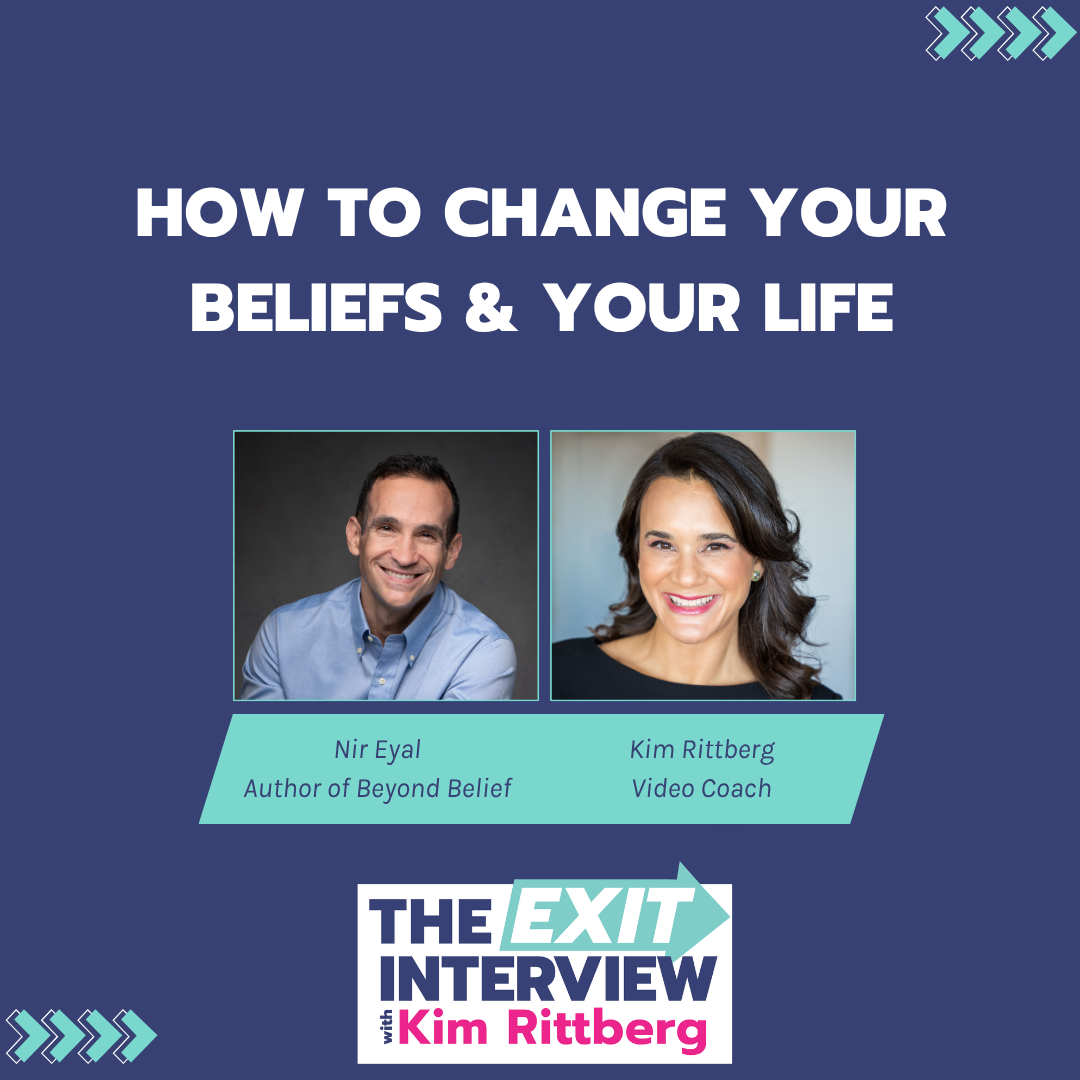
Ep. 172 / How to Overcome Limiting Beliefs and why “Positive Thinking” Isn’t Enough: Nir Eyal on his book Beyond Belief
SHOW NOTES:
Please leave a rating and review for the show!
++++++++++++++++++
What if the only thing holding you back isn't a lack of discipline—but a belief you don't even know you have?
In this episode, bestselling author Nir Eyal (Hooked, Indistractable, Beyond Belief) breaks down the science of limiting beliefs and reveals why positive thinking alone won't get you unstuck. If you've ever wanted to show up on video, grow your business on social media, or finally take action on goals you keep putting off—this conversation is for you.
Whether you're a business owner afraid to post on LinkedIn, a real estate agent who wants to start making videos, or an entrepreneur stuck in analysis paralysis—this episode gives you a practical, science-backed system to change your beliefs and finally take action.
You will learn:
Why motivation is more than discipline and productivity
How limiting beliefs quietly hold entrepreneurs back
Why fear of judgment stops people from posting content online
How to overcome imposter syndrome and gain confidence on camera
The science-backed framework for changing beliefs and taking action
Why positive thinking alone doesn’t work
Practical mindset strategies for business owners, creators, and real estate agents using social media and video marketing to grow their business
Did you love today’s episode?
1. Take a screenshot and share it to your IG stories. Tag me @kimrittberg
2. Leave us a rating and review on Apple Podcasts!
LISTEN BELOW! And don’t forget to ‘follow’ and leave a rating & review!
Click below to Follow, Review & Give a 5-star rating to Kim’s Exit Interview Podcast.
TRANSCRIPT:
(00:00) What if everything holding you back isn't a lack of discipline or motivation. It is a belief that you don't even know you have, but you can actually change that belief and build new habits, build new systems, build new structures to live and work differently. We are not talking about the power of positive thinking. This is not manifesting.
(00:24) This is actually changing your beliefs, changing your actions, and changing your life and is backed by science. I am so excited for this guest. Nir Eyal joins us. He is a New York Times best-selling author of Hooked, Indistractible, and his latest instant bestseller, Beyond Belief. He's going to break down the science and the system. Let's do it. Nir, thank you so much for joining me. I really enjoyed Beyond Belief.
(00:47) For those of you listening on literally holding it up like a like an advertisement, talk to me about, you know, you really are interested in habit formation. You wrote Hooked, talked about distraction and Indistractable. What made you think, okay, belief, belief is the thing I really want to dive into? Yeah, because I think beliefs are the missing link.
(01:04) I think we've completely misunderstood motivation that, you know, I was an econ major in high in college and uh we're taught that if you want someone to do something, you just have to give them an incentive. And by and large, that is true, except there's something missing. That uh it's not good enough to just tell people what to do, the behavior, and the benefit, why they should do it. Right? That's classic economics.
(01:26) If you if you know what to do and you know why you want to do it, you'll do it. But clearly there is something missing, right? That if it was that easy, if all we had to do was know what to do and then we would do it if we wanted to benefit, well then we'd all have six-pack abs and be multi-millionaires. Because today we all basically know what to do.
(01:45) Who doesn't know what to do? If you don't know what to do, Google it, ask chat GPT, right? Buy a book. The information is out there. There's no secrets anymore. Everybody who has anything to say is putting what they know on social media. So it's the answers are are out there. So why is it in in an age where we are all drowning in information? Why don't we do it? And so I wanted to dive deeper and I think the reason is is that motivation is not a straight line between behavior and benefit. That motivation is a triangle.
(02:11) That in order to sustain motivation, you not only need to know what to do, you not only need to know why you're doing it, the benefit, but you also have to have the belief, behavior, benefit, and belief. If you think about it, if if you're going to work for a boss and you don't believe that that boss is a good leader, maybe you don't believe they have your best interest at heart, maybe you don't believe they're going to give you that promotion or they know what they're doing to lead the company, are you going to work for them for very long? No. You're going to slack off and you'll find another job soon enough.
(02:37) Conversely, if you don't believe in your own ability to do the behavior, even if you know exactly what to do, you're not going to do it. Right? If you think, "Well, I'm never going to get in shape or it's too late or there's no time." Guess what? Even if you know what to do, it's not going to happen. So, I wanted to dive into this deeper reason why it's so difficult to change behavior and sustain motivation.
(02:59) It turns out that sustained motivation, persistence, is the number one determinant of success, but we don't talk about, you know, we buy books and we listen to podcasts and we watch YouTube videos telling us more and more and more information and we don't realize that the critical piece that we're missing is the belief.
(03:15) I love that. And just so people drive it home, give me that triangle again. Sure. Behavior, benefit, and belief. Yep. Knowing what to do, why you want to do it, and finally, the belief that sustains the motivation. Yep. Um, it's interesting. So, a lot of my work that I do now, and we'll talk more about this later, is about coaching people to be on camera.
(03:37) And when I first got out of media, I'd be like, "Okay, Nir, let's sit down and just start recording." But I had come from media where people were already really ready for camera. And now I would say I deal with a population where it's founders, it's CEOs, it's self-employed people. They want to be out there, but there's a lot of the mindset and the belief.
(03:56) And so I found this very interesting both for like my own personal psychological interest, but also professionally because a lot of it is mindset. So I found it I was really interested in like how do you take a concept of, you know, the negative, turn it into a positive, but then how do you actually turn that into action? So, I thought it was I thought that was something that um was really really interesting to me.
(04:14) Let's talk about the speaking of mindset and shifting our previous beliefs into more positive beliefs. Can you share with me a little bit about the agency the framework you have about agency? Like what takes someone from saying I want to do X thing. I'm working on shifting my mindset that I can do it and now I'm going to do it. So could talk to me about that framework. Yeah. So our beliefs have three powers.
(04:36) Our beliefs have the power to change what you see, what you feel, and ultimately what you do. So the three powers of belief are the power to change what you see. Literally change what you see, change what you feel, not just your feelings, not just your psychological state, but actually your physiological state. So how you actually experience pain and suffering is actually mediated by your beliefs.
(05:00) And finally, what you do, your sense of agency. Uh, and so when you master those three powers of belief, this is where you get this amazing unlock to fulfill your true potential. Okay, so I love this question and then so here's my thing. So let's say somebody like really wants it and they're pushing through. I actually I want to give a good example. A person wants to I'm trying to think.
(05:24) I'm I'm always so thinking about like my clients of what they want to do or even better. How about you? Do you have any uh any anything that's where you're stuck or frustrated or something's not working out? Anything causing you suffering? Yeah, we'll call my therapist circa 2018. Actually, let's let's actually I would love to use like an example client of mine because I think that's the work that I do that I see the most.
(05:44) Okay, let's take Jane and she runs her own business and she wants to start being more public, but she feels gripped by anxiety of the judgment. That's something that a lot of people have. the judge, the fear of judgment from people they know. Um, and a little bit of that impostor syndrome.
(06:05) Who am I to really put myself out there? So, using the things you learned in Beyond Belief, what could Jane do to start being more visible? Sure. Yeah. I think think about if there's a limiting belief that you might have because that's always the most fun. But, oh my god, I know. I'm gonna think about that too. I'm gonna think about that. Okay. This exact scenario.
(06:26) So when I started uh my my public speaking career I immediately realized that I had something you don't want as a public speaker I had terrible stage fright. I mean really bad stage fright. I would get the pounding heart. I would get the sweaty armpits. I'd get the cotton mouth. All that stuff. And right before I would go on stage I would I would start entering into this anxiety spiral.
(06:42) exactly as you said this fear of um I'm not good enough for this and what if they what if I mess up and they see that I messed up my career is going to be over and what's going to happen and I I would go down this terrible spiral that many times you know I I'll be honest with you I I had to back out of speaking engagements that I just thought I wasn't ready for I wasn't qualified for and I was limiting myself based on these beliefs that I had that weren't true they weren't facts they weren't laws of physics they were just limiting beliefs and so a big part of overcoming our limiting beliefs is realizing that
(07:14) number one, they're hidden. They're always hidden to us. A limiting belief is like your face. Okay? We all have a face, but you can't see your own face, right? You can't not the same way you could see your hands or your feet. If I said, "Look at your face.
(07:31) " Unless you have something outside of you, like a mirror or a Zoom call, you can't see your own face. You need something outside of yourself. Interestingly, we can all see other people's faces just like we can see other people's limiting beliefs, right? You can see your parents limiting beliefs, your kids limiting beliefs, your colleagues, your boss, you can see everybody else's limiting beliefs, but you can't see your own because to you they feel like facts, not beliefs.
(07:51) So, it's important to realize that in order to see our limitations, the things that we think are facts but are not, are just limiting beliefs, we have to reflect. We have to enter this process. And this is really what the book is about.
(08:09) It's a technique called inquirybased stress reduction where it's been validated now in several studies where we need a process to uncover those limiting beliefs. And let me tell you, Kim, I've met billionaires. I've met people who are broke. Everybody's got these limiting beliefs. You know, the person who's amazing at business, terrible with their family, the person who's uh incredible uh academically and uh you know, doesn't go to the gym.
(08:28) You know, we all have these limitations in one area of our life or another. even when we're exceptional in one area of our life or another. So uncovering those those limitations, uncovering those limiting beliefs is absolutely critical to break through those barriers.
(08:42) So how did I do this with my speaking career which today is is what I do for a living and I love. I changed the belief. I realized that stage fright is not a disease just like impostor syndrome. I'm going to bust your bubble. There is no such thing. Nobody's ever walked into a doctor's office and the doctor says, "Oh, let me give you a prescription because you've got imposter syndrome. It sounds scientific. It sounds medical." It's not. It's made up. It's a belief.
(09:07) There's no blood test. There's no X-ray. It's in your head. Okay? And we love it because it makes us feel better. Oh, you see, I I I I'm a perfectionist. I I couldn't possibly I can't deliver that on time. Oh, you know what? I I I can't I'm I have impostor syndrome. I would love to, but I have imposter. I'm so sorry. My doctor told me I'm 107 on imposter syndrome. I can't do it.
(09:31) Exactly. So, I changed the story. It wasn't serving me. Right. The story is now, and I'll tell you right now, Kim, I still experience the same physiological symptoms. My heart is racing. You've got a very popular podcast. A lot of people are listening right now. I might mess up. I know that. I've got the sweaty armpits. I've got the cotton mouth.
(09:49) That's why I've got my drink of water right here, just in case. I still feel the same exact physiological symptoms. They're never going to go away. What changed is my interpretation of those physiological symptoms, my belief about them. Pain is not suffering. Pain is information. Suffering is the interpretation of that information. So now I have a new belief.
(10:12) You see, the reason my heart is pumping so fast, it's not because I'm anxious. It's not because I'm going to mess up. It's because my brain needs more oxygen to deliver my best possible presentation. And I literally have to tell myself that every time I go on stage or do a podcast. Now, is it true? I don't know. I'm not a doctor, but I'll tell you what, it's useful. And so, this is the big unlock that beliefs are tools, not truths.
(10:41) Beliefs are tools, not truths. A fact is an objective truth. You cannot change facts. Faith is a conviction that does not require evidence. People almost never change their faith. But there's something in between. A belief. A belief is a conviction that is open to revision based on new evidence. And what makes beliefs so special is that they are malleable.
(11:03) Unlike facts, which you cannot change, faith, which almost never changes, you can change your beliefs based on whether they serve you. So does it serve you to say I have imposter syndrome? Does it serve you to say I don't have any time? Does it serve you to say I'm no good at this? Does it serve me to say I have stage fright? No, it didn't. It limited me. And so I can change that belief. It doesn't have to be a fact. It can be a story that I choose that serves me better.
(11:30) I love that. And when I read it in the book, a couple things, of course, by the way, I read it on vacation. I took all these notes on my phone and then I'm like, I can't read these notes. Um what really connected with me also was the idea of as you were just saying reframing your belief because it is something you can change and that actually the reframe changes your brain's wiring like you are changing not just the words you say but actually changing your brain because I feel that I had a lot of self-limiting beliefs when I started my business so I really wanted to like have a bigger voice but I
(12:03) came from corporate where basically like you work in your cubicle and like you don't there's not a tall poppy. You don't put yourself out there and that works for the situation you're in. That's fine mostly.
(12:20) And then when I launched my business, I knew I wanted to be speaking, but I also was scared and was like, who wants to hear from me? What am I going to talk about? There's always someone more successful, more knowledgeable, richer, better looking than you that's on, you know, that's doing the thing you want to do. And so I just started to reframe it as like there are people who do want to hear. I actually do have expertise.
(12:36) there are people who are behind me in their career who want to learn and I started doing the things that you actually advocate in your book and I found that really helpful and similar to you my very first keynote I mean I thought I really wanted to do the keynote I pitched for it I was psyched about it in the one minute before the keynote I mean I thought I was going to throw up legitimately and like and wet my pants at the same time I was really terrified and I just said you're doing this because it's fun you're doing this because it's fun and I smiled and and I went right out there
(13:07) and just even saying like remember why you're doing this. And so that's something that I I teach my clients a lot is take your motivation, put it on a sticky note, that's the thing you're working towards because it is really hard. I find like I see in my work I think it's hard to change it's hard to change actions because of what you're saying.
(13:26) It's hard to change the beliefs, right? Yeah. And we have to remember that our brain hates changing its mind. Your brain hates changing its mind. that we have these limiting beliefs for a reason. We have them because evolutionarily your brain doesn't care if you did that talk. Your brain doesn't care if you're flourishing. Your brain doesn't care if you're happy.
(13:47) Your brain doesn't care if you're meeting your full potential. Your brain's primary directive is to keep you alive. That's it. And so, whatever served you in the past, whatever got you here, that's what your brain is going to continue to get you to do and believe because hey, you didn't die before. you're probably not going to die in the future if you keep doing and believing what you've always done and believed.
(14:11) So, your brain is trying to protect you, but it's pulling you constantly into passivity. It's constantly telling you, "You're not good enough. There's no time. They're going to laugh at you. People like you don't do this." It's going to constantly keep whispering that in your ear unless you actively take steps to say, "Thanks very much.
(14:28) I know what you're doing there, but I'm going to choose a different perspective." And by those small actions of saying I am choosing this belief. It's not a fact. It's a belief and I can choose a liberating belief over a limiting belief. You start to prove it to yourself that hey actually this is actually fun and I can do this and there is plenty of time and I I enjoy this rather than I'm suffering from this.
(14:53) And that that is the big unlock when you look at people who are successful at anything. Okay? Whether it's athletics, whether it's the arts, whether it's business, you look at people in the top of their game across the board, the secret is that they don't see pain the way we see pain. To them, the same exact input, right? The same exact signal, the same exact information, the same things happen to them. They're interpreting completely differently.
(15:20) It's like the person who says, you know, my dad was an alcoholic and that's why I'm so successful. versus the person who says, "My dad was an alcoholic and that's why I'm so unsuccessful." Right? It's what it's not what happens. It's your interpretation of what happens. Sickness is not illness. Pain is not suffering. Those are all separate things. Emotions are not feelings. Those are all separate things. And knowing the difference between the two changes your life.
(15:46) I I really like also that it's um not looking back, not to say you're denying someone's past experiences, but not living in the past and in fact pausing and saying, "Okay, these things happened." Maybe I did go on stage in seventh grade and I spoke and everyone laughed at me. Okay, that was seventh grade, sorry, when I was seven. That's a little old. It's a little older for the really horrifying moment to happen.
(16:11) But like let's say when you're seven you're on stage and everyone laughs at you and that's the moment you hold on to and you instead can say okay that did happen that is a truth I'm not denying that truth but from now on I'm going to say this new thing. So well even that I just have sorry to interrupt you have to tell you a quick story.
(16:26) So, uh there was a friend of mine, a good friend of mine here in Singapore where I live and um uh I was telling him about Beyond Belief as I was writing it and uh you know, we we were talking about it and he says, "You know, that really reminds me of this problem that I have.
(16:46) " You know, see, I've dated a lot of women in my life and every time I get serious with a woman, um I always have the same problem that they they leave because I'm not emotionally available. And the reason I'm not emotionally available is because when I was 6 years old, I went to my cousin's funeral. And I remember at my cousin's funeral, you know, he died very young. And I remember how sad everyone was. And I decided from that day onward that I would not cry ever again.
(17:10) From six years old, I was never going to cry ever again. And he tells this story to his sister, his older sister, about how it's so difficult for him to hold on to relationships with women he likes because of because of this problem and how, you know, he attended that funeral and he always remembers it.
(17:27) She turns to him and says, "You know, you weren't at that funeral. I went to that funeral. You were at home with the babysitter because you were too young to go." And and he had created this this entire story about his past. You see, even if something does happen to you in the past, and I'm not denying it, right? Like I don't know what happened to to you and and and and all pain is real and everything that that you know is causing you suffering is real. Suffering, all suffering is real. And all suffering happens in the brain.
(17:57) All pain happens in the brain. Doesn't mean it's fake, but it's all happening in the brain. So many times even what happens to us, we don't remember clearly. And so and and most importantly, we can't change it. Which is why we see this real turn away from this trauma focused therapy that says, "Oh, everything is because of what my parents did. Everything is because of what happened to me in the past.
(18:17) Everything is because of yesteryear and that's why I behave the way I do." Of course, that does have an effect. We our beliefs come from somewhere, right? Our priors come from somewhere. but fixating on what happened.
(18:32) You know, even if let's say when you were in when you were seven years old or seventh grade or whatever and you did gave that talk and you bombed and people laughed at you, you only saw a pinhole perspective of what happened. You didn't see the people at the back of the room who thought you did great or who were cheering for you or were were admiring the fact that you had the guts to even get on stage in the first place because you only saw reality through this tiny pinhole which you probably don't even remember accurately.
(18:53) I promise you it didn't happen the way you remembered. It happened way too long ago. So the the point is to focus on what's keeping us stuck today and then questioning. This is called inquiry based stress reduction where we question whether that belief necessarily is a fact or is it a belief? Is it objective or is it subjective? And if it's subjective, do we have to hold on to it? And then I know just because we're talking about the science of this, this book took you five years to research. Can you just like pause six? Okay,
(19:25) sorry. I'm I'm I'm making you lazy. I'm making you lazy with every year counts. Every minute I'm five. I can't do the math of 365* 6 that fast. Anyway, talk to me about why it took you five to six years to write this book because there's a lot of misinformation out there. There's a lot of things that I thought were true turned out not to be true. There's a lot of things that I had uh I I just didn't believe could exist.
(19:52) Like for example, I'll tell you a quick story. Talk about how pain is not suffering. I met a guy by the name of Daniel Gistler. And Daniel is a a commodities trader in Switzerland. Very numbers guy, right? Very analytical, you know, very black and white type of guy. And when in his early 50s, he has this freak accident where he breaks some bones in his ankle.
(20:14) And he has to have pins put into his ankle in order to let the bones heal. And it takes a couple years for them to heal properly. And in that time he stumbles across a YouTube video about a technique called hypnosedation. And he learns Daniel learns uh in this in the course of the time when he has to wait for these pins to be taken out.
(20:39) He learns to manage his pain in such a way that he is able to undergo a 55minute procedure where scalpel is cutting into flesh where metal is yanked from bone. He undergoes this entire 55minute procedure with no local anesthesia, no general anesthesia, nothing. There isn't even an anesthesiologist in the room.
(21:04) And so part of the reason the book took me so long was because I wanted to get to the bottom of is this real? Is this a fact? Turns out it is a fact that tens of thousands of people are able to do this. Now, why do I tell you this story? Do I want everybody to go out there and get surgery without anesthesia? Definitely not. I'm not doing it. I'll tell you that at least not anytime soon.
(21:20) But I tell this story because if human beings, right, Daniel doesn't have any special genes, right? It's just a skill like any other, right? That you know, riding a bike or driving a car is very difficult until you learn how to do it. The same goes with this hypnosed.
(21:37) He learned how to use the power of his mind, the power of his beliefs to separate pain from suffering. And he was able to undergo this surgery for 55 minutes without anesthesia. Well, if Daniel can do that, what can we do? Are you telling me we can't go on stage without loving it and being beholden? Are we saying if I could go surgery with no medicine with a scalpel, then I think you could get on the stage, right? I can't go to the gym because I don't want to. I can't have that difficult conversation because it's going to be icky.
(22:07) Of course, we can, right? If we believe we can. And so I wanted to open people's minds to unlock what's already within us. We all have these amazing powers that, you know, I'm a very science-back guy. I don't like the woo woo and the manifesting stuff. I want the science. And there's 30 pages of citations to peer-reviewed studies.
(22:22) And I'm telling you, the science will blow your mind. It has definitely blown my mind. I remembered reading the I was I'm sort of smiling as you're telling these stories because I've read them in the book and I was like, I remember that one. What I found very interesting and I think I was on vacation with my daughter. I was like you should read this part.
(22:46) It was the one I find very interesting that there's that sort of the power of positive thinking. But what I like about the book that I noticed and I would love for you to talk about this is that especially with pain management the positive thinking has a big impact. Like we're not saying you can mantra your way out of cancer. That is not what we're saying.
(23:09) But I did find that really really interesting because obviously there's a lot of pain and then pain connects to a lot of other things in our life. So talk to me a little bit about the sort of power of positive thinking and what it can do in terms of physical and what it can't. Right. So positive thinking as most people conceptualize it is actually not only doesn't work, it's actually harmful.
(23:27) that there's a real negative side to positive thinking and that you know the manifesting the vision boarding it turns out from a motivational perspective that just thinking positive actually doesn't work and and this comes from the work of Gabriele Oettingen she actually connected uh people to blood pressure monitors as they were doing visualization exercises as they were manifesting vision boarding you know imagining the beach body imagining abundance imagining my mansion with my beautiful spouse and when they were doing that they actually became more relaxed their blood pressure dropped and they became less likely to do the things that it would take to get those things.
(24:02) So, in in a few famous studies, you know, students who visualized getting an A, not only did they not study as as much, they ended up getting poorer grades than the students who didn't do the visualization exercises because they said, "Well, I visualized. I manifested. It's just going to happen." That doesn't work. Okay, that does not work. What does work is called mental contrasting.
(24:23) When you look at athletes, for example, it's a great example of how the self-help industry took something that was true and made it false. That when you think about athletes, and you know, we all know that athletes visualize. They definitely do, but what do athletes visualize? Athletes don't visualize the gold medal and the trophy.
(24:40) Athletes visualize what they will do when difficulty gets in their way. What they will do physically as well as psychologically when they face an obstacle. Okay? So, I'm on offense and defense is coming at me. What am I going to do? I'm skiing down the mountain and I lose my balance.
(24:57) What am I going to do for for, you know, for what you do? One of the most important things is, hey, let's say I do forget my lines. Okay? What am I going to do? That's what you want to prepare for. Not, oh my god, I'm going to be the next, you know, Brené Brown and Simon Sinek. That's not helpful. Don't visualize that crap. Don't manifest that.
(25:18) Rather, how will I prepare for the pain? How will I prepare for the pain? Like one of the exercises I do sometimes, you know, to to get over my nerves of being on stage is I'll I'll pick a random slide in my deck. Okay, a random slide. Slide 42. Go like no context. I didn't get there by, you know, reciting, but random slide. Uh, not okay. Let me take a breath.
(25:41) Okay, this is what I think I can do to get back on track. So, I've prepared for the pain. I prepared for the worst case scenario. That's the right way to visualize this mental contrasting technique. Now, when it comes to you asked about how do beliefs affect our our pain response. Turns out that many of our maladies, you know, I I mentioned earlier that sickness is not illness. That sickness is in the body. Illness is in the mind.
(26:09) And in fact, did you know that 80% of our health care expenditures go into illness, not sickness? So, insomnia, depression, anxiety, chronic pain, fibromyalgia, all these things are in the mind, right? That doesn't mean it's not real. I'm not saying it's not real. All pain is real. All pain is real. I want to be very loud and clear. And yet, all pain is in the mind.
(26:35) Where else could it be, right? Back pain isn't in your back, right? Shoulder pain is in your shoulder. Pain is in the brain. Because your pain is processed, the signal is processed always in your brain. Where else could it be processed? Turns out that your pain is modulated by your beliefs.
(26:53) So when you hyperfixate, I mean this is why you look at the medical community, you know, a few years ago during the opioid epidemic, part of the reason we had an opioid epidemic is because we were constantly asking people how much pain they were in. Doctors were told that pain was a vital sign. You collect blood pressure, heart rate, temperature, and you ask people about their pain. And if you went into a doctor's office 10 years ago, you would see this little pain scale. Remember those where they would say, you know, how much pain are you in?
(27:18) You just walked in for a checkup. How much pain are you in, right? And what turned out that by hyperfocusing on pain, pain, pain, pain, pain. It's dangerous. It's dangerous. We actually put people in pain. We actually created the pain because when you hyperfocus on something, your brain believes it's dangerous.
(27:39) That danger causes physiological symptoms which turn up the pain dial and this is the source of chronic pain. Chronic pain is pain that occurs for longer than six months that doesn't have any known physiological cause. Okay, you hurt your back. Six months later, if it still hurts and we can't find anything that's actually damaged, it's it's called chronic pain. And it's caused not by uh by physical damage.
(28:05) It's caused by neuroplastic damage. Meaning your brain has turned up the signal to create that pain from very small uh pieces of information that it's very scared is going to lead to an outbreak, is going to lead to a a you know, a condition that's going to be make it feel even worse. So, how does this relate to to public speaking? It's exactly the same thing.
(28:29) If I always fixate on what could go wrong and what if this happens and what if that happens and I don't close that loop and prepare for that pain and know, okay, when the worst case scenario happens, here's what I'm going to do. Okay, I've practiced the worst case scenario 16,000 times and when it happens, no big deal because I prepared for it. Versus being scared, being scared, being scared, being scared.
(28:47) It's it only accentuates the fear which accentuates the suffering. I think that's interesting. One of the things people also come to me with, they say, "What if someone writes a mean comment on my post?" Like that's something that comes up, not that often, but every once in a while. Yeah. And the real realistic part of me is like most people are not that famous that we're even getting mean comments. Yeah. Maybe you be so lucky.
(29:09) You be so lucky. I'm like, the point at which you're getting trolls means you made it. But anyway, right. But that that doesn't hit as well as um maybe a more productive thing. I do like the idea of like okay what will we say to ourselves when one person writes one mean thing which does happen you know one person writes one mean thing like how are we going to respond to that right like what's the mental exercise well I I say well that person must be pretty sad in their basement like eating cheese and playing video games and they're not brave enough
(29:37) to put themselves out there that's what I say I'm like you know what I'm doing a thing it's really much easier to criticize someone else than actually do it yourself but I do think that That makes me think about, you know, how do we reframe the potential but unlikely negative scenarios? And also, I think tapping into what is most likely, you know, is it that likely you're going to forget your lines? Is it that likely your people are going to troll you? Probably not, but still prepare for that.
(30:03) The thing that the implicit assumption there that should be called out is what if somebody puts a mean comment? That's going to cause me suffering. Okay, that that the missing part, you know, like um like why is something determined to be bad? Because we think it's going to cause us suffering. Okay, that's what's worth testing.
(30:27) So, somebody's going to leave a bad comment. Let's say somebody leaves a bad comment. Why is that necessarily going to cause you suffering? Is there any potential world where that doesn't cause you suffering? I bet you you can think of a ton of reasons why. Somebody leaves you a bad comment.
(30:51) Why does that not cause you suffering? Well, because it'd be really funny, right? Like it would be like like somebody wrote somebody wrote on my Goodreads about beyond belief. Somebody wrote, "It's so easy to write non-fiction, right? Like I didn't even finish the book of one star. I got one star comment." They said something like that. It was really funny because my wife and I were joking about like, "Okay, can't wait to see your book, right? Like try it out for yourself.
(31:12) " Uh, so, okay, maybe it doesn't cause me suffering because it's funny. That's one reason. Maybe it doesn't cause me suffering because I learn from it. Great. Amazing. Somebody leaves me a comment that says, "The book sucks." Awesome. I get to make the next book better. Thank you for being honest and helping me make the book better.
(31:28) I mean, I I could go on and on and on. like that, you know, I think with all these things when we test the assumption that pain causes suffering, I mean, the Buddhists said this a long time ago and and and now medical science uh backs this up. There's doesn't necessarily have to be a connection there that pain is just information. It's just a signal.
(31:51) Whether it's somebody commenting online, whether it's a tweak in your back, whether it's somebody hurt your feelings, it's just information. It doesn't have to necessarily cause you suffering. Oh, that's such a mindset shift. I feel like I talked years ago with my public speaking coach about how I I mean if it's her or someone else when we get feedback to your point. I bet you remember that one star review and I'm sure you have 1,000 3,000. I didn't check. I'm going to write my review.
(32:16) 1,000 3,000 five star reviews and you actually still remember the one star review. So why is it that also do we hold on to that negative because it is evolutionarily helpful? Yeah, we have what's called a negativity bias because good things are nice but bad things will kill you. So we we need to know that, right? We need to know that we have that penchant for bad stuff.
(32:40) I mean this is why the news business is around, right? As a former news journalist. Yes. Uh yeah, hey, I was a journalism co-major in school. I mean if it bleeds, it leads. Nobody wants to tell you how many people were pulled out of poverty today, even though that should be a headline news story. It's amazing how many people are being pulled out of of of poverty.
(33:00) Nobody's telling you about the flights that didn't crash. Nobody tells you about all the diseases that people didn't die from today that that a 100 years ago, 50 years ago, they would have died from because we don't care if it bleeds, it leaves. That's what we want to know.
(33:16) And so, we have this negativity bias that's constantly trying to keep us safe. and it's not that you're never going to get away. You're never going to uh change that per se, but recognizing that it's there means you can do something about it. You can say, "Thanks. Okay, I appreciate that you're trying to protect me. You're trying to keep you alive. I mean, alive.
(33:34) Thanks, evolution, but that's not helpful right now. I choose to believe something different because I choose not to suffer." Right? There just has to be a lot of that really proactive like it's the selft talk like you have to be very proactive in terms of changing your beliefs and then changing your actions.
(33:49) So like it really has to come right it has to come in that order. Um I had to put literally sticky notes all over my desk uh to like so for example with writing you know I've written three bestsellers. Writing is really really hard work. When I write all I want to do is you know go check stock prices or sports scores or the news or anything but the writing.
(34:10) But it wasn't until I changed my beliefs about writing that every time I would get bored or insecure or lonely or whatever, I always wanted to do something else. Let me check email. Let me research. Let me get out of this because I thought that boredom was bad. That feeling bad is bad.
(34:35) Well, guess what my new belief is? And I literally had to put a post-it note on my keyboard, right? Like on my keyboard so that I would move it to the right and see it every time I started writing. My new belief, and I have to tell myself this all the time, is this is what it feels like to get better. This is what it feels like to get better. And now I've replaced that limiting belief of feeling bad is bad with a liberating belief.
(34:54) This is what it feels like to get better. That feeling crummy, that hard, that difficult, that uh that signal, that pain, again, it's just information. I was interpreting it as suffering. But now I interpret it as something else. that this is what it feels like when I'm getting better. By the way, I feel like such a wimp that I couldn't think of a self-limiting belief. It's like, not that I'm perfect.
(35:16) I'm sure I have plenty of self-limiting beliefs. But you were like, Kim, give me your own self-limiting beliefs and we'll work through that. I was like, um, but maybe we could play that after. We'll play the game of we'll play the game of slice through the self-limiting belief. Oh, you got one. No, I'm gonna go to it after. I'm gonna finish my question then.
(35:37) So, first of all, I actually was a research assistant with Martin Seligman's lab at Penn as an undergrad. Amazing. I didn't know that. I realize I should like see if my name is like in page number 10, 12 somewhere. But I did some of some interviews with people for his happiness work, his positive psychology work. So, I've always been interested in this as a concept.
(35:56) I should have said this like 30 minutes ago. Talk to me a little bit about like the hope circuit, helplessness. I I I found that really interesting. Not that we are, you know, rats in water, but I find the idea of helplessness and fear and hope very interesting both psychologically, but also as it pertains to all of us in our everyday life. So, talk to me a little bit about that.
(36:16) Yeah. Oh, it's great. So, um so it's it's amazing that you worked with Seligman. I mean, he's he's a legend. Well, I wouldn't say with him. I think I was like with his underlings. I don't think I ever met him, just to be clear, but I worked in his lab. like I did do some of I did I did research for a semester as a part of that.
(36:32) Amazing. Amazing. So So he co-authored a a a super famous study uh called about learned helplessness and and everybody in the psychology community knew about learned helplessness.
(36:49) It's kind of something that you know even in pop psychology most people have have heard of this idea that you learn to be helpless that if you keep failing and failing eventually you just give up. And so this explained a lot of social phenomenon, you know, generational poverty, all kinds of social problems. Uh, Seligman became president of the American Psychological Association. But a few years ago, being the good scientist that he is, him and Maier
, the the two people who did the study, they actually took a look at the data and they realized that not only was learned helplessness wrong, that they had come to the wrong conclusion, but in fact, the exact opposite is true. that
(37:23) we don't learn helplessness, we are born helpless. That if you think about a baby comes into the world completely helpless. It is totally dependent on its caregivers in order to survive. What we have to learn is not helplessness but in fact what we learn is hope. And I'll give you the study that perfectly demonstrates this. There was a study done by Curt Richter.
(37:44) It was a biologist back in the 1950s. And Richter had a very simple question. He wanted to know how long a wild rat could swim in water. So he took a group of wild rats, he put them in a cylinder of water and he stood there and he timed them and he found that they swam for about 15 minutes before they just kind of gave up and drown. Now he wanted to see he had a second question.
(38:07) Could he teach these rats to be more persistent? Could he motivate them somehow to get them to keep swimming? Now remember, they were swimming for their lives. So he couldn't just give them more cheese or something, right? and they were in cylinders of water swimming for their lives. So what did he do? He took a new group of rats. He put them in the same exact cylinders.
(38:24) He timed for about 15 minutes when he knew they were going to start giving up. And he did in fact see them start struggling. He reached in, he pulled out the rat, dried it off, let it and then after it caught its breath for a quick second, plunk back into the water it went. And he did this a few times.
(38:44) So he conditioned the rats to expect that if they kept swimming, salvation might be possible. Now you've read the book, so I'm not going to ask you, but most people when I ask them, how much longer did the rat swim for? Was Richter successful at increasing the persistence of these rats? And if so, how much longer did they swim? Now, some people say, oh, maybe he doubled, right? Maybe they went from 15 minutes to 30 minutes.
(39:08) Doubled their persistence. That would be incredible. Some people say, no, 60 minutes. you know, a full hour of swimming. Wouldn't that be amazing? Imagine if there was some kind of intervention that could make you four times more persistent.
(39:24) That would be incredible, right? Run a marathon, four marathons back-to-back, uh, you know, make four times the sales calls, uh, whatever it might be. Do four times more persistent. That would be incredible. But that's not what happened. The rats didn't swim for 60 minutes. The rats swam for 60 hours. 60 hours of non-stop swimming, they became 240 times more persistent. Now, why? What happened? They didn't become Michael Phelps rats, right? They didn't become physically any different. Their bodies were exactly the same.
(39:58) Their environment hadn't changed. It was the same exact cylinders of water, same exact experiment. The only thing left, we can't ask the rats obviously, but presumably the only factor left was that something changed in their minds, that this conditioning had flipped some kind of switch in their brains that suddenly taught them hope, right? Their default state was helplessness.
(40:21) They gave up after 15 minutes because what was the point of continuing to try? But when they learned hope, they persisted. This is why we call it the hope floats experiment. So because that flip that switch had been flipped, what was always within them was suddenly unlocked. That is the power of beliefs. Remember we talked about uh Daniel Gistler with his surgery and we talked about how pain is is something that can be managed through your beliefs.
(40:48) These things that seem absolutely absurd, ridiculous. There's no way it's in us. It's in each and every one of us. We just don't know it because we keep quitting at 15 minutes when we all have these 60 hours, so to speak, metaphorically. It's always there. We just don't realize it. One other thing I found really interesting was the Nocebo effect.
(41:11) That really blew me away. Talk talk a little bit about that. Sure. Yeah. So, placebo is comes from the Greek I will heal. Uh Nocebo means I will hurt. the opposite of the placebo effect which is almost what we think about like being psychosomatic like it's when you know your your aunt is like I'm sick again you're like it's psychosomatic it's like that's Nocebo basically and it it happens all the time that we uh they've done studies with uh patients who uh are told they are given chemotherapy will start losing their hair even when it's just a saline solution when there's
(41:45) a completely inert substance so it's real this noa I'll give you a perfect example there was in the case literature there's There's a guy uh who's been anonymized and he's called Mr. A. Now, this is a real story. Mr.
(42:01) A was uh had a very bad breakup with his girlfriend and he decides that he wants to commit suicide. He's done. So, he goes to his medicine cabinet. He takes out an entire pill jar of anti-depressants. He takes the entire jar of pills, swallows every single one. And just as he's swallowing the last pill, he changes his mind. He says he wants to live after all. He asks his friend to rush him to the hospital. By the time he gets to the hospital, he collapses on the floor. He tells the doctors, "I took all my pills. I took all my pills.
(42:26) " And he hands them the pill jar and he he faints. He becomes unconscious. And the doctors, they put him on a gurney. They're wheeling him into the operating room. They're trying to figure out what he's overdosed on. And they realize that his blood pressure is dropping, that his heart rate is dangerously low.
(42:46) And they look on the pill jar, and they're trying to figure out what anti-depressant did he take, what has he overdosed on? They look on the pill jar and it doesn't say the name of the drug. And this is a big problem. They need to figure out how to help him. Instead, what it says is a phone number. They call the phone number and they determined that Mr.
(43:05) A was in a clinical trial and he was and he was taking these anti-depressants as part of this clinical trial except for the fact that he hadn't taken the anti-depressants. He had taken a placebo. He was in the control group. Nothing in the pills he swallowed could possibly have caused the fainting and the low blood pressure and the heart rate. Nothing could have caused these physiological conditions.
(43:26) It was totally a noibo effect. Now the doctors tell Mr. A this and within 15 minutes his heart rate stabilizes, his blood pressure returns to normal and he walks out of the hospital completely healthy, maybe a little embarrassed. So this is a wonderful example of how our beliefs can literally become our biology that if convinced being convinced that I have overdosed causes these kind of physiological symptoms what else does it do for us right what other labels create our limitations uh and this happens all the
(44:00) time when you tell yourself that you are something or you are not something oftentimes you will conform to that label and this is it's what it's our brain actually rewiring to match the belief like is that what's happening inside? It's your brain trying to protect you from danger. So when the brain has so you have these real limits. Okay, we definitely all have real limits.
(44:27) You know the rats eventually after 60 hours that was it had those limits. But ironically the their brains was was trying to protect them. It's called the central governor theory that your brain has like this little speedometer. Like for example, like you've ever have you've ever gone in a golf cart and at the golf range or at the golf course they set the golf cart to not go too fast even though it can go faster. They say, "Okay, don't go past that certain speed limit because we don't want you to be dangerous, you know, to get yourself in danger.
(44:51) " So they set this governor that makes sure that it doesn't go any faster. So your brain is doing that to you way before your actual limits. So you go on a jog, are you gonna die? No, you're not going to die. But you feel really bad as you're jogging. It hurts, right? You feel like, I've got nothing left. You're nowhere near having nothing left. Not even close.
(45:15) But it's your brain trying to protect you because it doesn't really care if you get exercise, right? It doesn't know about those long-term benefits. It just wants to keep you alive. And anything that feels like it might put you in danger, it's going to say, "No, no, no. Stop. Stop. Stop. Stop. Stop." And so we do that all the time. It happens socially. It happens physiologically. It happens emotionally.
(45:31) It happens because our brains are trying to protect us. Great. Okay, I have three more book questions and then two questions on your pivot. So, this show we talked to a lot of people who've shifted from one thing to another. So, I want to ask you that at the very end. Okay.
(45:53) So, what is the thing you want a reader to do within the first 48 hours after reading this book? I want you to realize three things. Number one, that you're you that you do not see reality clearly. That you see reality filtered based on your beliefs. Number two, I want you to realize that you are capable of far more than you can ever imagine. And that number three, that your beliefs become your reality.
(46:13) Not not everybody's reality, your reality, your perception of reality. And just even that understanding is going to make you live differently. Yeah. Yeah. I think I think if anything, it's it's the intellectual humility to realize that we don't see the world clearly. I think that's super important. I mean, we don't even see our own world clearly.
(46:37) Let alone think, "Oh, we we definitely know what somebody said when they hurt our feelings, we know their intentions, right? If somebody cuts on traffic, that jerk or you know, geopolitical conflicts, oh yeah, those these are the good guys, these are bad guys. I definitely have it all figured out." You can't even see your own reality clearly. You're telling me you can see reality clearly through other people's perspective. Not even close.
(46:53) Okay. Okay. So now using your framework and I took some notes. I'm I probably am applying it wrong but I want to do using your framework step by step how someone could go from like take one of my clients. We're going to give that person a name Diana. Okay. She's feeling not just I would say stage because I think it's different because a stage is a moment and I actually think that putting yourself on video is has more of that fear of social judgment and that's in addition to all the negative self-talk. So, let's talk step by step. If
(47:24) somebody client Diana wants to start showing up on camera and she has these negative negative and self-limiting beliefs, what are the steps that from your book she should take to go from I'm afraid I want to put myself out there, but I have all of these negative thoughts. Um, let's take us to the step.
(47:42) So, first step one, spot the limiting belief. So, where are you stuck first? Start with that. Where where is there something in your life that is causing you suffering? Okay. I want to repair that relationship. I want to get on stage. I want to write that book. I want to start that business. I want to go to the gym. Why aren't you doing it? Okay.
(48:00) So, Diana, you you have a dream to go on What did you say? It's I I want to put myself out there on social media. On video. Yeah. On social media. On video. Yep. Video. I want to start publishing uh my videos on social media. I I I know I want to do that, but I'm not doing it. Okay, Diana. Why aren't you doing it? Well, I don't like it. Why don't you like it? Well, I feel like I'm going to be judged. Okay, now now we we've gotten somewhere.
(48:22) Okay, so that's a belief. Write down that belief that putting myself on social media means people are going to judge me and that's bad. Okay, that's we're doing the hypers speed version here. But what we want to get to is what is causing you suffering. So something something something is bad is causing me suffering. Okay, so being judged by others causes me suffering. Now, we have a belief.
(48:48) Now, we ask ourselves these four questions that come from inquiry based stress reduction. We we don't have time to do them all with Diana here and she's not here, but essentially I'll give the four to you. Number one, is it true? Number two, is it really true? Is it absolutely true? Number three, who am I when I hold on to this belief? And number four, who would I be without this belief? This is called inquirybased stress reduction. It's also known as the work by Byron Katie.
(49:09) It's it's incredible. And then what we're going to do is we're going to do a turnaround. or we're going to ask ourself, could the exact opposite be true? Okay, could the exact opposite be true? Kind of like what we did earlier. And then we're going to collect a portfolio of perspectives. We're not going to change our mind. We're just going to collect a portfolio of perspectives.
(49:28) How could it not be true that being judged by others could cause me suffering? Is there any way? Sounds ridiculous. I bet you you could find three or four, five, maybe 10 different ways that actually being judged by others could be awesome. Sounds crazy. Try it. I bet you you'll find ways that it could actually be not so bad. I can get better from it. I can learn from it.
(49:47) I only live once. What do I care what other people think? I mean, it just goes on and on. It's It sounds ridiculous, but once you start doing it, you'll see it's actually there are many, many ways where the exact opposite could also be true. Then what we do, we try it on. Just like we try a new pair of shoes, right? When we go into the shoe store, we don't just say, "Give me those. I don't care what size they're in." We try them on. We, you know, see, is it a good fit? Do we like the style? We walk around the store. We try the same with
(50:11) this belief. So, we take that belief that uh being judged by others is bad. We try take that belief and we try for a week. Being judged by others is great. Let's just say I'm just we're going hypers speed here. How could that be true? And what would that feel like? I'm just going to choose to believe it.
(50:28) Does it matter if it's true? Nope. It doesn't matter if it's true because beliefs are tools, not truths. I'm just going to try on this for size. And you know what? You say, "How could that possibly be true? How could being judged by others be good?" I bet you Simon Sinek, Adam Grant, Brené Brown love being judged by others. Love it. Professionals love being judged by others. So it's not so crazy. It can be true.
(50:51) They use it as a tool, not a truth. So believe it. You try it on for size and then you see did it work for you. If it did, you keep it. If it doesn't work for you, you can always try a different belief. That's the basic process. I love that. I'm I as you notice, by the way, I have a pencil and I'm taking notes on this even though I have a transcription and I'm gonna get that. But I uh I'm like a writing based thing.
(51:12) I love that. This is so great. And I really love that it's both the mindset but also the actionable tips because it's great to change your mind. And then okay, now I know that I'm my mindset's off or my beliefs are limiting. Okay. And what? So I I love that in Beyond belief it pushes us to actually take the action.
(51:35) Um because then you're collecting the evidence, right?by doing that, by trying it on for size and saying, "Whoa, you know what? When I believe, I love feedback. I love being judged by others. Yeah. How do I behave? Who do I become? What do I do?" And now I'm collecting evidence that actually makes that belief true. I was thinking about the portfolio of opinions more for my personal life. So, I'm an extrovert and I'm friendly and optimistic.
(51:56) Sometimes I will see people who and they'll not be warm or or not be friendly and I will basically think that person doesn't like me. My husband will say, "Is it possible they're shy?" I think it's possible, but I think we all come in with our We're totally biased, of course. But it does help me think maybe that person's shy or or maybe that person didn't see me or maybe that person's occupied with their own business or maybe that person doesn't like me and that's awesome. Yeah.
(52:20) One less I have to waste time with so I can spend time with people who do like me. Amazing. Totally. Totally. That's a whole separate mindset, Jeff, is oh, it's okay if someone doesn't like you. That's okay. And then, okay, I'd love to shift gears because I do love to ask people about their shifts, exit interviews about exiting one thing, entering another. I know you've been a serial entrepreneur.
(52:39) Did you ever envision yourself as being a person with a like one or two or three long-term jobs? I know you kind of you've launched a lot of businesses and now you're an author and a speaker. Were you ever going to be that sort of corporate person? My So, my first job out of college was uh at Boston Consulting Group where I was a management consultant. didn't like that at all. But I did that.
(52:59) I did my tour of duty. Uh then I started a solar energy business and uh we were fortunate enough to get bought by a private equity firm. Uh and then I went to business school and then I started um after that I started another company in the advertising and gaming space and then that was okay.
(53:16) We raised a bunch of VC capital and uh it was all right. Not not a great outcome but all right like a base hit. Uh and then I started writing books and uh I wrote it I wrote I started writing for myself frankly just to solve my own problems and I didn't know you could do it as a career and then I just loved it and so I I I love like I don't write books because of what I know. I write because of what I want to know.
(53:38) Uh that's what guides me. I I constantly want to follow my curiosity. And so I've got a problem. I read other people's books on the topic. If I if that doesn't solve it for me then now I want to research it. I want to go back to first principles and figure it out for myself. So that's that's what drives me.
(53:52) What what advice would you have for someone who's interested in writing books and speaking? So I can only give autobiographical advice, right? I'll tell you what worked for me. That bringing readers along for a big question that I'm trying to answer that that to me is a lot of fun because then I can't lose, right? I'm making a book for myself that I want to learn something about like for indistractible. I I wanted to to learn how to manage distraction and and the books that just well stop using email, stop checking social media.
(54:21) Well, thanks stupid. Like that's not very helpful. I need to keep my job, right? How am I going to make that work? Same with belief. Like I I had all these things I wanted to do that I wasn't doing and I wasn't I was stuck in many areas of my life and I didn't know why. Um so I think that's the best advice I can give to people is is follow your curiosity. Don't write about what you already know.
(54:40) Even though that's kind of the advice that that fiction authors are told, you know, write something that you know intimately. For me, non-fiction, it it only works for me when I'm on a quest, when I have a big question that I want answered. Yeah, that's great. Is there anything you I didn't ask you that you'd like to share? No, this was a lot of fun. You you asked some great questions and uh I really enjoyed it. I hope you did, too.
(55:01) I hope this isn't like opposite way. You know how sometimes things are near, thank you so much. So where can people obviously people can buy beyond belief at their local bookstore online connect let people know how they can buy your books follow you all of that. Yeah. So, it's at nirandfar. Nir is like my first name. So, it's nirandfar.com. And if you go to nirandfar.com
(55:22), there's actually a five minute belief change guide, which is totally free. You don't have to pay anything. Just go to nirandfar.com and you'll see a fiveminute belief change guide uh that will get you started on this whole process of discovering your limiting beliefs and adopting liberating ones. Thank you so much. This has been great.
(55:38) My pleasure. Thank you.
Timestamps & Highlights:
0:00 – Why beliefs are the missing link in motivation
3:15 – The motivation triangle explained
6:05 – Overcoming fear of judgment and imposter syndrome
9:49 – Pain vs. suffering: reframing stage fright
11:30 – Beliefs are tools, not truths
16:11 – Why fixating on the past keeps you stuck
19:25 – The surgery without anesthesia study
23:27 – Why positive thinking backfires (and what works instead)
31:51 – The hope floats experiment 41:11 – Nocebo effect: when beliefs become biology 47:24 – Step-by-step framework for changing limiting beliefs
52:39 – Nir's career journey and advice for aspiring authors
FREE DOWNLOAD: How to Use AI to Make Better Videos + Bonus 10 Ways to Make Magnetic Videos https://www.kimrittberg.com/tips
Follow host Kim Rittberg on Instagram https://www.instagram.com/kimrittberg
Subscribe to Kim's YouTube Channel http://youtube.com/@kimrittbergcontent to Make Better Videos that Convert
Connect with Nir:
Website: http://nirandfar.com
LinkedIn: https://www.linkedin.com/in/nireyal/
Instagram: http://instagram.com/nireyal
Book: Beyond Belief: geni.us/beyondbelief
Free belief change guide: www.nirandfar.com/beyond-belief-live
Bonus content and the 30-Day Belief Transformation Journal is here: nirandfar.com/beyond-belief
Please spread the word to your friends and leave us a rating and review on Apple Podcasts!