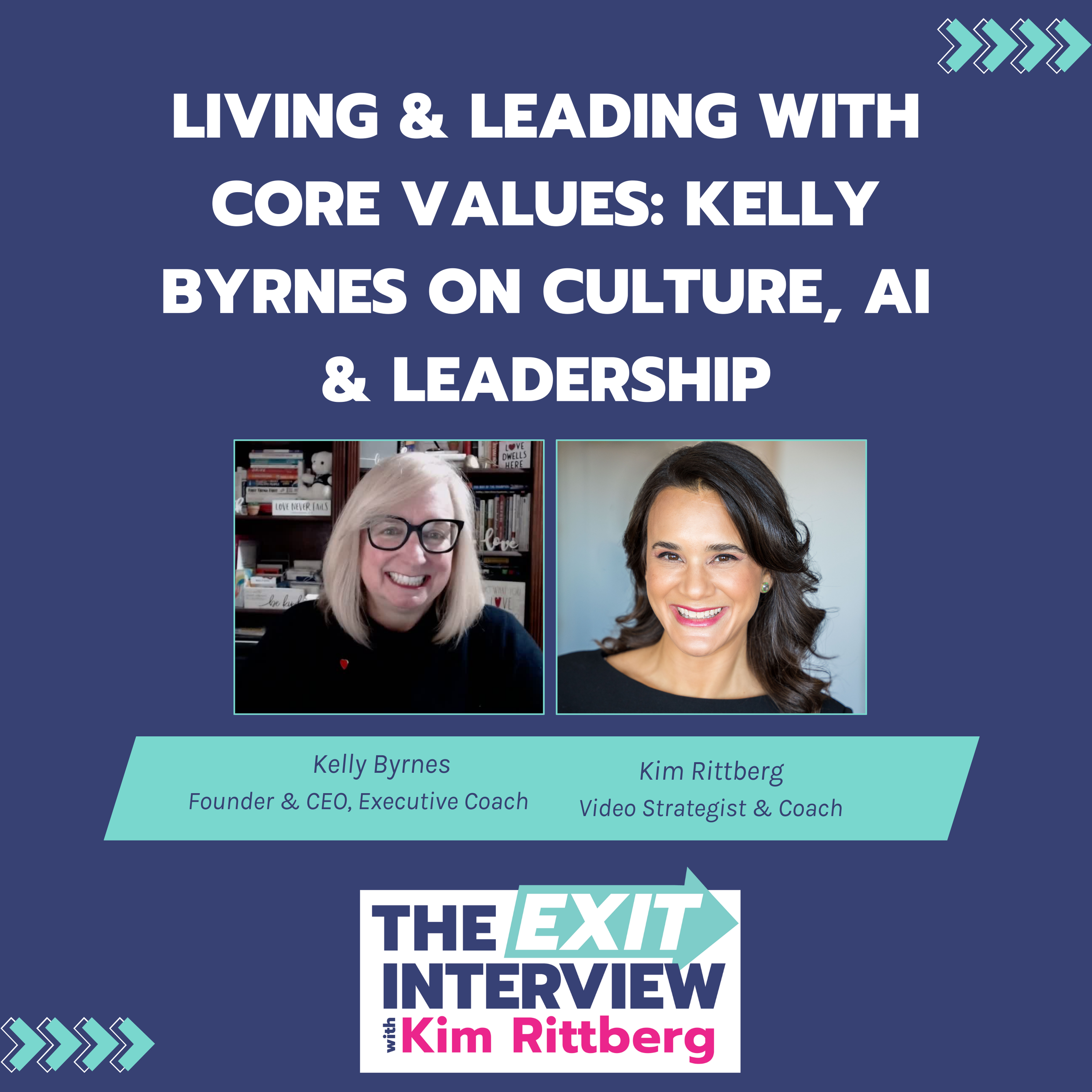
Ep. 169 / Living & Leading with Core Values: Kelly Byrnes on Culture, AI & Leadership
SHOW NOTES:
Please leave a rating and review for the show!
++++++++++++++++++
In this episode, we talk with Kelly Byrnes, founder of Voyage Consulting Group (VCG) and a globally recognized leadership advisor. With publications in Harvard Business Review, Forbes, and the Wall Street Journal, Kelly brings a refreshing, grounded perspective on what leadership should look like in 2025 and beyond.
Kelly Byrnes is a former Chief Talent Officer who founded Voyage Consulting Group in 2016. She also is an adjunct MBA professor for Rockhurst University, and an author whose work has been in Harvard Business Review, Forbes, and The Wall Street Journal.
Named one of the region’s Most Influential Women and inducted into the Kansas City Business Hall of Fame, she brings decades of executive leadership experience and a proven record of transforming culture and performance.
Through Voyage Consulting Group (VCG), Kelly has advised leaders across healthcare, technology, engineering, construction, architecture, marketing, financial services, and more. She helps executives anticipate and solve people-related challenges that impact revenue, retention, and reputation—serving as their advisor on leadership and company culture.
Kelly is the author of The Basics of Gen AI, founding leader of the AI Collective Kansas City, and hosts The AI Roundtable. She also hosts Culture Matters and the Leadership Book of the Month. She has served on several boards and currently serves on the board for the Ignatian Spirituality Center.
She holds an MBA, BA, Harvard’s Certificate in Disruptive Strategy, SHRM-SCP, SPHR, and executive coaching certifications.
You will learn:
Why “culture surveys” fail and what companies should measure instead
The four pillars of a healthy organization: Purpose, Principles, People, Performance
The #1 mistake leaders make with hybrid work
How the Mirror Test can transform self-awareness and leadership presence
Why authenticity beats imitation — and how leaders can show up as themselves
How to build an AI strategy that aligns with your values
What inspired Kelly’s new book: The Basics of GenAI
Did you love today’s episode?
1. Take a screenshot and share it to your IG stories. Tag me @kimrittberg
2. Leave us a rating and review on Apple Podcasts!
LISTEN BELOW! And don’t forget to ‘follow’ and leave a rating & review!
Click below to Follow, Review & Give a 5-star rating to Kim’s Exit Interview Podcast.
TRANSCRIPT:
(00:00) I am really excited because we have Kelly Byrnes here joining us. She is a former Chief Talent officer who founded Voyage Consulting Group in 2016. She's also an adjunct MBA professor for Rockhurst University and an author whose work has been in Harvard Business Review, Forbes, and the Wall Street Journal.
(00:20) She is named one of the region's Most Influential women and inducted into the Kansas City Business Hall of Fame. and she brings decades of executive leadership experience and a proven record of transforming culture and performance. Through VCG, Voyage Consulting Group, Kelly has advised leaders across healthcare, technology, engineering, construction, architecture, marketing, financial services, and more.
(00:38) She helps executives anticipate and solve people related challenges that impact revenue, retention, and reputation, serving as their adviser on leadership and company culture. Kelly is the author of the basics of Gen AI , founding leader of the AI collective Kansas City and hosts the AI round table.
(00:58) She also hosts Culture Matters and the Leadership Book of the month. She has served on several boards and currently serves on the board for the Ignatian Spirituality center. She holds an MBA, BA, a Harvard’s Certificate in Disruptive Strategy, SHRM-SCP, SPHR, and executive coaching certifications.
(01:14) She and her husband Bob, an Air Force veteran and retired fire captain, live in Kansas City, Missouri. Her volunteer work centers around their parish, education, children, and dogs. Kelly, thank you so much for joining us. Thanks, Kim. It's great to be with you. I love that. I have so many questions. So many questions. I want to dive right in.
(01:30) Tell me, uh, what made you start your own business? And let's be honest, what was the hardest part? So, my first business I started when I was a kid, so I got early. Um, got in on it early. And my dad was an entrepreneur. So, I saw some of the hard parts. But in launching Voyage Consulting Group in 2016, I launched it because I saw a room in the market. I saw something was missing in the market and that was on a deep dive to understand companies and not just the survey. It's not enough. So I had a skill in that had a reputation for that.
(02:01) So I launched the company. But one of the hardest parts is shifting from being a chief talent officer and a director into um an entrepreneur again. even though I'd worn the hat before, but the um just it's a change in who your conversations are with and positioning myself more and you know talking about the stories and the truth and the facts and not being overly humble and then nobody wants to work with you because it sounds like you're generic.
(02:30) So that was something I definitely had to practice and still work on. Yeah. Yeah. And I know it's funny because so Kelly and I have worked together and I know that I say to her and I'm always very honest with my clients who are coaches or consultants. It is hard because a lot of the work you do is solutions-oriented and that becomes hard to message.
(02:46) There are obviously lots of ways to do it and I do that with my clients but it can become sort of um advice and quotes and but what does that actually mean? Right? So, I love how you're bringing that up front. And so, talk to me. What do you think in your work with leadership in these companies? What is the biggest thing companies are doing wrong? And how can they shift it to do it right? You know, the biggest thing I've seen lately specifically is the um work from home, hybrid, that whole policy. I've had a few clients reach out in the last year about that. Then it just seems
(03:17) like that they're doing not my not my clients anymore but I keep reading about they're doing such a bad job in the communication of that. So companies are communicating as come in and be a team and um they started with that and then when the employees came in they're bringing their laptops from home working on their laptops in Zoom meetings with other people in the building on Zoom meetings.
(03:42) So the leaders aren't setting a um a great they're not being great role models in working together and uh setting up conference rooms and being in person with people. Um but then the communication of it turned harsh because they own the properties and you know I get it but it turned harsh like demanding people come in and like that's just no way to encourage people to see the value in being together and I started my career when it was work in the office. I'm still connected with so many people from those early days and
(04:13) and there are things that matter from that and it's not the same it's not just um stand at the coffee machine with people or be at zoom you know there's a lot that can happen there and they're just wording it so poorly and talk to me about I know before we started chatting on the podcast we were talking about people the culture and all of that and there are three Rs that it impacts that you work on give the audience a little bit of what are the specific things that you focus on in your work. So I focus I the three Rs are revenue, uh retention and reputation and those
(04:47) are three things that end up coming out of the survey. And then um our model of fixing or implementation, resolving has to do with purpose, principles, people and uh performance in that order. So the um but we don't just assess oh are people nice to each other and do you buy pizzas on Fridays and that people tend to think that's what culture is culture is way beyond that um broader and deeper so we assess across several areas and um I and give a company health report based on revenue retention and reputation and um
(05:25) and those the systems that support that as well. So then the solutions can be related to the people things which would be my expertise and then um I have other experts in operations and systems and um data analytics and other areas um financial side as well that um I know just enough about but I would not presume to offer solutions in those areas.
(05:48) Great. And I know we wanted to cover a little bit today of living and leading in alignment with your core values for personal fulfillment. What does that mean? So, explain that to me. What does that mean for a leader and why is it important to the rest of the company that we do that? Yeah.
(06:07) Um, I work with great leaders, but most people haven't spent time reflecting on or discerning their personal core values. So, um, if anybody wants an exercise, I'll send it to them for free and just they can email me. But there's a lot of complicated exercises. I have a simple one to help them get started. But identify I like three.
(06:25) If you can come up with just three main core values that will be your kind of your guard rails and they'll be the ultimate process part of your decision- making process. So, as you're making decisions about how to behave all day long, most of them are going to be natural. They're going to fall in line. They're going to be great.
(06:47) Other things you might struggle with and have to look, wait, how does this align with the company core values? And if that doesn't give you any joy, then how does it align with my personal core values? And there may be times that those don't all align. So stick with your personal ones and have those conversations to figure that out. But the thing is if they if they don't know what their personal core values are, it's easy to get swayed by other people.
(07:09) And so then you can get swayed making decisions that don't align with the company or your own core values and just even everyday behaviors. I talked with a client the other day and um I wear this little red heart every day when I put it on. I say a little prayer and it reminds me one of my core values is love. So be about the love.
(07:27) You say that's your core value. That's what you think about. Then be that way every day. But then when I see it in the mirror and I see it on, you know, the reflection and Zoom meetings and all, then it reminds me intentionally to be that way. So, this client and I were talking about it and you know there's within um you know I could go to my car in rush hour and within two minutes be upset about traffic and um I like streaming creative words together when I'm in my car but I wouldn't flip the bird or really yell at anybody. But um but I you know I don't want to be the one that gets to work and
(07:59) is cursing and in a bad mood and complaining about the about traffic that everybody else was into. Um or even gossiping or things like that. somebody can start gossiping about somebody and before you know it, you're sucked in. That's not aligned with this. So, I can I pull myself out faster because I'm more centered in that core value.
(08:18) I like that. And then one of the couple of things that you had said to me about the things that you focus on is one is pay attention to the market and then another is changing targets and approach part of the business like don't be afraid to pivot.
(08:37) um are those some of the lessons that you go in as you build help the company build up its leadership and really should shape that? Yeah. Yeah. Sometimes leaders are um they're kind of upset because they um the customers the big customer left or they can't get the same customers again, but the customer's needs might have changed. And so if you can meet those needs now, go for that.
(08:55) But if you can't get different people, go learn a different market, you know, and other people might still need what you're offering, but they might not. Um, and then you need to change what you're offering, but you have more than one idea, I'm sure, and so do your people on your team. So figure out what you all could do together.
(09:13) But I do see that as a mistake that companies don't change fast enough. So my recommended solution to that is always pay attention to the market. So to your customers and their customers. So that's who I'm keeping in mind when I'm working with my c my clients is who are their customers. So if their customers are changing, then they need to change too, right? It's not just them.
(09:37) Talk to me about the mirror test. What is the mirror test? Yeah. So the mirror test is look yourself in the mirror in the morning while you're brushing your teeth. So you don't even have to do a separate whole thing about it. Excuse me. And while you're brushing your teeth, decide who you're going to be today. So that's a great place to check in on your core values.
(09:57) So am I bringing the love today? That's all I'm thinking during my brushing my teeth. And so I'm not ruminating of all the things I have to do today. I'm thinking about my core values and how am I showing up? And then throughout the day when you're washing your hands in the mirror again, um give yourself the test.
(10:17) How am I doing? And man, sometimes by like nine o'clock I need a reset, but I'd rather know at nine than like three weeks later. So, that's the test. Like, figure out if you're how you're doing, if you need a reset, if you're doing all right. And then the test part is um after the end of the day and you're brushing your teeth again in front of that mirror, give yourself the test.
(10:36) How did I do? How did I do today according to my core values and what I said this morning? Did I show up intentionally how I want to? And there's going to be days a lot where you say, "Eek, I wasn't great at that." And that's okay. And tomorrow's another day. the act of thinking about it on purpose while brushing your teeth um ends the day. So then as soon as I'm done brushing my teeth, I don't ruminate on it anymore.
(10:57) Those people aren't coming to bed with me. They're not, you know, in my car if I'm going somewhere. Like that's the end. So then recognizing that too helps free the brain up uh for a better night's sleep. And then you start the day fresh the next day. So that's the mirror test and I hope everybody takes it. It's a great way to stay centered.
(11:15) And I like what you were saying earlier about the fulfillment. So it's really the core values is about it's clearly about personal fulfillment but also in the end what you're saying is when the leaders are checked in with their core values and really following what is important to them that's going to help them be more successful, help the people working for them be happier and really help with that retention and revenue piece.
(11:45) And the other are hold on reputation but reputation is more external but that revenue and the retention piece is super important. So I assume when we're thinking about why core values are so important is that you're not just letting the chaos and the ocean and the churn of the world every day impact you but instead staying focused and that will keep you more personally fulfilled but also your team and those around you eyes on the prize.
(12:07) What are we focusing on for this quarter and this year and big picture for the company? Right. And the more you're centered in what you're bringing in, the more you can be um open to seeing other people. If you if you're not centered and doing okay with your own life and core values, then then people end up getting judgmental and defensive. And so that's when they're well, why did they say that to me? And what why? Like, no, you don't need to compare.
(12:31) Focus on what you're doing. Let them be or chime in on for them. But um the uh if you're if you're not comfortable and confident in who you are and clear, those are other words I use too. Clarity can lead to confidence that leads to the courage to be a leader.
(12:49) If you're not clear on those things, then you're too wishy-washy, too prone to succumb to what other people are saying. And then um people kind of laugh about entrepreneurs. they chase squirrels like some hot thing comes along and okay well part of that is because not being centered in what it is that you really want to bring or do and who you are you know who that that that aligns with your truth um so one example of that that I've seen is some people that say they want to bring the high energy as the senior leader bring the high energy and be like the cheerleader and what's his name Richard over virgin the um virgin
(13:23) Richard Branson you know, like him that's all out there. Okay, but if your personality isn't really that, there's going to be a disconnect. You can go pretend you're those things, but you're going to be stressed trying to get there. You're going to feel in congruent when you're up there, and it's going to come across incongruent is the word.
(13:42) And so, it's people can feel that disconnect and tell that that's really not who you are. So, tone it down a notch. Be yourself. bring in another person to be the Richard Branson if you need to. But um you know align . It's funny because the work we do as you're talking about it, it makes me think about when I have clients and I'm advising them on how to present publicly, right? So I help people message themselves publicly and I think about that too when people say how am I how can I be more confident on camera or how can I leverage video? I think about it's transferring who you actually are
(14:15) interpersonally in meetings and sales meetings to a more public front. So if you're super outgoing or wise or empathetic, it's really just about harnessing that and showing it off. It's not about becoming somebody else, but it's really about me teaching you how to harness that and then what are the specific skills to actually bring that to video. That's a whole other thing.
(14:40) But it is to your point not stepping into trying to be somebody else but rather raising yourself. And it's funny as we're talking, I'm thinking about when I was in leadership positions in media, I had realized as I was becoming a leader, basically I built I built the video unit for US Weekly Magazine, and we scaled really quickly.
(14:59) And I was ready for a leadership role for sure, but we went from like three people to 17 people in like less than a year. And it was so busy that sometimes I would forget to step back and remember why people always enjoyed working with me. Like always my reviews in as I was more junior and then mid-level were always like you're a joy to have in the office.
(15:22) Like you're always a team player and you work hard and but I found myself just like hair on fire. There's always so much to do that I forgot to like pause like have everyone in the room and be like how's everyone doing? And that's actually real Kim. And so I think it just it took me a little bit to process, oh wait, my core value is who I actually am, who people actually enjoy is the real Kim, the Kim that's not so crazy. And it took me a minute. I was also like a new mom, like hustling back for my child.
(15:46) But the point is, we're in the office for however many hours we're there. It's not it doesn't cost a lot of money and it doesn't take a lot of effort to take 5 to 10 minutes and just like have your room in group in a room and say, "How's everyone doing? What are you excited about? How's it feeling? Any issues, any wins? And I think it just it took me a little bit to realize that, but as you're thinking about it, that would be really what I call my core values. Yeah. The connection.
(16:11) Would you say it's the connection or the visibility or describe that? Yeah, I would say. So, I would say um confidence is the confidence in whoever you are. Whether you're extroverted, introverted, wise, empathetic, sweet, funny, whatever. Whatever you are is who you are. That's great.
(16:30) So I think it's the confidence in who you are and being that but then the clarity of what do you bring all the time like being super aware. So you took video boot camp before we even start making videos I have everyone do a brand dive. Who are you? I hate the word brand but people understand that. Who are you as a professional right? What is important to you? And everyone has a different idea of that.
(16:54) What's important to you? What would your friends and family say about you? What would your favorite colleagues say about you? What are your best attributes? and what are you passionate about? All of that stuff has to become the blueprint for how you are publicly. And so for me, the things that I'm passionate about is like having fun. Like I always think that there should be some element of fun otherwise why are we doing this? Um but being curious and pushing ourselves like I'm not I've never been good with people on my team just kind of being in like uh what's it called? Um when you're paddling in water and you're just staying in place. Oh yeah. Yeah. Like people who want to stay in place are probably not a good fit for
(17:26) me. It's people who are curious and want to shift move for move ourselves forward. But being real that that's who I am. That's who I vibe with. And I think that I've been better about that as an entrepreneur at being more clear about who I am being Kim who wears like a magenta jumpsuit on a stage and not afraid of that.
(17:44) And I didn't necessarily harness that so well all the time at the beginning of my executive career. Yeah. And same for me too. I I worked so hard on proving I was smart and um I think I was so serious for some of it and then um then like I wouldn't have worn a heart early in my career or even though we were close the team that I had back then we were close but it was just different and I you know just um I I will end LinkedIn posts once in a while and I say peace, joy, love.
(18:12) That's what I say in real life and I don't do it on like my analysis of Warren Buffett's letter that's coming out soon. I didn't. But you could but you could I could but I'm using it for when there's a topic that's that would could benefit from that like and I'm okay with that. I'm comfortable with that. But other people might not be and they don't need to be.
(18:29) They So if somebody is um they're more introverted or not as open with their feelings and the buzzword right now is to be authentic and be um vulnerable and share all the things and they're not comfortable sharing. They don't need to share their private personal moments. And I think that comes across as a disconnect too. And totally awkward. Totally.
(18:52) And I think it's interesting this idea of like authenticity and whatever. I found it very hard when I first was being more public on social media to build my own business like maybe six years ago. But I think when I really tapped into what do I actually enjoy talking about and what do I actually enjoy teaching? It's about video. It's about confidence.
(19:10) I've been training people to be on camera for 15 years. I actually think there are a lot of things people are doing wrong. people are thinking about it wrong, but I also want to say here's how you can do it better and you can do it and I like to be encouraging. So those are the things that thank you. Those are the pieces that are true to me.
(19:29) So once I focused on that and once I focused on that and also being more honest about my story of like I started my business because I had kids and I loved my media career but I did not see that it would be compatible. I was working in the hospital during childbirth. I didn't see my media job as being compatible. So being more honest about that and then coming forward with the passion and I think to your point whether you're being public in sort of building your professional brand your personal brand publicly or building your leadership internally. It really is about checking in and saying what do I care about? What's important to me? And
(20:00) what do people already value about me? Because I think that you know whenever you meet someone and they're like I'm so warm and you're like are you like how are your is that what your friends say about you? Okay, you know but being self-aware and actually checking in with your family and friends and saying what would you say about me? So I think it's it there's so many parallels between how do you lead internally and then how do you present externally because also another you know communications consultant that I love that I work with named Jennifer Lemmert you know she reminded me
(20:31) of the quote your um what is it your personal brand is what people say about you behind your back. Yeah. When you're not in the room. Reputation is Yeah. Right. Right. Your reputation is what people say when you're not in the room.
(20:48) that has to be the same when you're on a stage, when you're on LinkedIn, and when you're in the office. And if there's a disconnect, one part one of those two groups, the public or the internal corporate are not going to appreciate that. That's right. And it's easy to see even just subconsciously people recognize that.
(21:06) And sometimes people really are the friendly, loving, but it's for like six people that work there. But how do you treat the other 40 or 200 or you know how are you with those people? And some senior leaders will say, "Oh, I love my team. I get along great with my team." They made their direct reports, but they come to the senior leadership team and they have silos and they're hoarding information and they're not being a team player in those. Yeah, totally.
(21:30) And your story about the um the video and why you started your company. Um, and one of the thoughts you asked me think ahead of time about what advice would I give people and one of them was um to read the market. And so you're what you're offering is aligned with what the market needs.
(21:47) But sometimes I see entrepreneurs that um will come up with something and other people are saying do what you love and create a business around what you love and you know like I love walking dogs. I love walking our dog and um but people aren't going to pay me to do that. And even if I started dog walking, which I know somebody that did that, um that's not going to be enough to do the things that I want to do. And you know, that's not my long-term solution. So, it's um and in my neighborhood, too.
(22:12) That's there's not enough. So, um knowing the market is really important. And so, if you're a tech person and you have a tech idea and you don't study the market to see does this become a one off product or is it going to create a company? Because if it's a product, the sales will how will the sales end and then is there a part two? Is there a 2. 0 version
(22:38) and all that and come people get stuck on that and then they get so upset and wonder why I invest all this time and money and they could have had a job. So know the market is important. Yeah. So true. And I know you had mentioned that you your father was an entrepreneur and my father was also an entrepreneur. How did it shape you in terms of becoming an entrepreneur? Yeah.
(22:54) So when we were kids, my dad worked from home and so we had to answer our phone in a very professional manner. And yes, it was very funny. And then one of my first jobs in grade school, u my dad was in the automotive import business. He um had the first Honda dealership in the Midwest. So I worked there on Saturdays and I'd have to answer the phone there.
(23:12) Thank you for calling Stadium Honda. But sometimes I'd say that at home. I answered the phone at the rectory at our church. I I'd get so messed up and so it was so embarrassing to do that. But the we after a while we got to know who was calling my dad. We got to know some of them and um just through the phone.
(23:30) And so then if I'd mess up they were funny and would forgive and I remember learning that and my dad will bring up somebody today back from then and I I only knew them from the phone. I never met the people but he'll talk about what they're doing now or he heard from them and I'll remember a lot of those names. So like the
influence his company had on me was the relationship building and uh and keeping those and you know he hasn't done that for a long time but some of the people still reach out and you know he still has contacts from way back then is so nice. So that stuck with me.
(24:01) That's really funny that you were your first basically your first job was you were a operator for your dad's business. That's right. You were a phone operator. That's right. That is so funny. Um, talk to me about you wrote a book on AI.
(24:19) How did that come about? What is the book about? I feel like it's so amazing because you must have really been at the forefront. So, talk to me about writing the book on AI. Okay. So, funny. I started hearing all the buzz like write it two years ago, right? Two or three years ago. And um I didn't get it. I did I kept going, isn't this what robotics was in high school? Like why is everyone making such a big deal out of this? So, I didn't get it.
(24:36) And um but then a friend pro um showed me did a zoom and like showed me his screen for chat GPT and then I understood. So oh wow. So then I started using it and as I got more into using it figuring things out and just saw the time that it saved and I don't know that the quality is so much better because I usually give it the idea but the just the speed of the general things that I use it for is so helpful.
(25:08) And so I kept meeting um other leaders and I'd ask about their AI use and they would say, "Oh, Kelly, we can't use AI. We can't put our customer data in there." And then I'd say, "But you can do 80 million other things." Like, come on. And I know these clients are going to get left behind by their competitors who are using it.
(25:27) So I thought, "Well, I'm just gonna I started giving them ideas and like get gave a road map of how they could start using it." And so I just put that into a guide and um the basics of Gen AI and I kept it. It's 20 bucks. So some companies have told me they're using it as the training manual for their team and it's literally here's how you create an account on um OpenAI and um and there's disclaimers in there.
(25:51) Uh there's um over a hundred usage examples, entrepreneurs and enterprise-wide personal examples are in there. And there's guard rails. So I understand the risks and the fear. And so there's I haven't counted. I know at least 50 different ways to overcome that risk and that fear. And um so that's what that's about why I wrote it.
(26:11) And you were saying the companies were afraid to put their company customer data in there. Totally fine. What are sort of the top three ways you'd recommend your clients use OpenAI? Well, I think small businesses could use it by putting their customer data, but you can I used it. I created a spreadsheet and didn't put the names of the people.
(26:28) I wanted to see what it would come up with for personas for marketing. and I wanted four and I put in around I think 10,000 um names or um companies and titles and locations and um just from that um basic information for personas and two of them were kind of similar. So I said okay you can go up to seven personas and then I figured out from the seven that five would be um good for me and what I was working on.
(26:55) So the analysis of all of that was very useful. And then obviously you can do it with just put in your top 20 clients and a little bit more data about them to get those personas. But if you don't know who you're talking to, that's how the personas help if I mean I know you know this but people listening might not all that.
(27:13) So the personas help you talk to the people that you really need to be talking to instead of who you are and what you're thinking. And then another thing they can do is plan meeting agendas. and I host three things that are held every month. I and they're not they're all free, but I was spending way too much time on the research and coming up with a meeting agenda for these free things and they need to be top-notch, the high qualities there, but I can put my ideas in and then it can formalize the structure for me. So, it probably saves an hour every month for each of those things. And the 10,000 company or 10,000 leaders
(27:46) that you got, where did you get that information from? from LinkedIn and from my database, my own database. Yeah, I love that. And I like what you were saying earlier. I use I've been teaching how to use AI for video over the past like year, year and a half, two years. And I agree with you. I think the efficiency is amazing.
(28:05) And I recommend how I recommend people use AI for video is incredible for brainstorming ideas, incredible for script writing. Um, but really important is you putting in who you are before that. And so I have a prompt. So you know I give to my clients or people who reach out the prompts so that you can tell AI who you are so that the ideas are better and more specific to your point.
(28:29) I think that sometimes it's great at ideas and sometimes it's not, but it's the more specific it can get really good. And then one thing I really love, uh, if you, hot tip, uh, if you speak, you're a guest on a podcast or you give a speech, I've been putting in the transcript and I've been saying, build X for me, build Y for me, apply for this award for me based on this speech, this speaker page.
(28:52) Like, I have so much already out there. I'm like, I should not spend more than 10 minutes on X award application or X blog post only because it's already come from me. But I think the important thing and you're also doing it is like putting the knowledge that you do have and your ideas that you do want into it because I already say like here's what came from my mouth and use my turn of phrase. Don't paraphrase as chat GPT. Use the words that I say.
(29:17) Even if you don't like it, even if you don't like it, chat GPT, I want you to use Kim's voice. And so I really like those ideas. And I love your idea about the avatars and the personas because often I see that when people come to me, they have some ideas of who their clients are, but I agree with you that maybe they have one or two people in mind, but they don't have the others.
(29:35) Or sometimes we're using a sample set that's too small. It's like, well, my main two clients think this. Okay. Well, those are those two people. How do we expand it out to get more of the people and what are their struggles and what are their opportunities? So to your point, the better the personas are, the more you can serve them.
(29:53) So with content and messaging, it's you can talk to their struggles, you could talk to their solutions, the more you understand them. Yeah. Exactly. And it can do things it can add things like um the what's their life outside of work and like what tell it describe their personality like things that you wouldn't be talking about necessarily, but the more you get to know the people, the better.
(30:10) Yeah, I love that. And then you know AI is changing the landscape in so many ways and you really work with leadership. What is the biggest way that you see leaders will be impacted by AI and what can they do to harness it in the most beneficial way? Um it will it's by the time I say something and this is published there will be more ways but I I think the leaders need to have a strategy for using it and um I talk about that in the book too because over the years I've seen so many things become trendy and companies will invest you know thousands of dollars on a product a tech idea or something and
(30:44) then the person that champions it they leave and the whole thing falls apart like there's not really a strategy around it. So don't look at I think they need to not look at okay what can we do with AI identify what your challenges are where are you struggling what's taking too long what are some routine things that you do and that your people do and then is there an AI tool that could help solve that and the answer is probably yes there will be and so I would say start there that's the most important thing and be open to um practicing and trying AI um but also
(31:18) don't outsource your judgement. So the um that's the best thing and people will talk to me as an I'm an adjunct in the MBA program at Rockers and so and I teach strategic career management there and so people will talk about you know well is AI going to take our jobs and even entrepreneurs wonder that I'm like AI is not going to replace people that know stuff so know some things so know some things exactly know something have a take you know have an have a be able to draw lines and patterns and recognize these things and um the more you can do that
(31:52) the tool isn't going to be able to do that the best for everyone. Yeah. You know um I had it analyzed. Warren Buffett just wrote his last letter to the um to his company. So I wanted I read the letter. I came up with three or four ideas. I put it in chat GPT. What are your you know summary of this? Give your top 10 ideas.
(32:10) And I usually do ask it for 10 when I'm only going to use like three or four. But um but it came up with some that I didn't identify and then it didn't have one that I thought was important and I'm keeping it in my summary that I'm going to post like that. It doesn't think every single thing that I can think of.
(32:28) So, you know, I think have some confidence in that when you know stuff. Um don't be afraid of it. Find out how it can amplify instead of take over. Yeah, I think we very much see eye to eye about AI for that. Like I like to use it as a thought partner. I'm like, what do you think of this? And I read it and then I say, "Kim, what do you think of this?" Because I see a lot of people are taking the AI output and saying, "Yep." And I spoke about this at Fast Company Innovation Festival last year.
(32:54) What sort of rubric should you put it through? And so I taught like what you should ask yourself. I said, "So does it sound like me? Do I agree with it? Is it and is it generic?" If it doesn't sound like you, don't use it. Right? If you don't agree with it, don't use it.
(33:11) And if it's generic and it could be written for any leadership coach around the country, Kelly should not use it because Kelly is Kelly. Yes. And your audience wants to they don't want just um you know six adjectives in a row and then repeat it with six other like they repeat. Yes. Oh my gosh. That's Thank you for sharing that.
(33:30) That's a part that's so important that people don't always realize, but I can tell when something's written by one of those tools because it's so generic. Also, I tell I tell it, do not use the word thrive. I feel like it uses that word all the time. I've been saying get rid of all the M dashes. Yes. Yes. No more dashes alone. I will use plenty by myself, but I don't need it adding it in every other sentence. It's funny.
(33:54) So, my husband's a big M dash proponent, and I've never been into M dashes. It's not how I write. And so, I'm like, don't use the M dash. I don't write like that, you Now before we're going to jump into rapid fire um which we'll share more at the end uh how can people connect with you? How can they get advice from you? What's the best way people can connect with you? So I think the best way is through the website probably voyagecg.com
(34:12) for voyage consulting group but also I'm really active on LinkedIn and I accept invitations from people. So I usually look at every invitation. So if they send an invitation especially saying they heard about me from you from here um I would love to connect. So, LinkedIn and the website. Awesome. You ready? LinkedIn. I'm Kelly Tyler Burns.
(34:31) Great. Kelly Tyler Burns. And I'll have that linked down in the show notes for anybody listening. Okay, perfect. Great. All right, Kelly, are you ready for some rap? We got some We're rubbing our hands together like starting a fire. Okay. Share a story of a weird or embarrassing work moment. Oh my gosh.
(34:51) Although for Oh, I don't want to. The first one that came to mind was I was a speaker for um a national organization doing training and development. So traveling around the country five cities a week and the sessions were heavily booked and you don't have a lot of breaks and when there's breaks you're talking to the people.
(35:10) So like a hundred people in the room and I was up on the stage and I really needed to exit for the ladies room and I did not make it fast. I like made up an exercise and I said, "Okay, now's the time to do this reflection." Like totally made it up on the spot because I knew I didn't have enough time for the next break or the end.
(35:27) And then I quickly ran off the stage and I like it was I'm sure the people that saw me running out probably realized what had happened. Yes, that was so embarrassing. Yeah. Not a favorite moment. That's really funny. I do a lot of public speaking and I'm always worried.
(35:45) Do you ever see the original Naked Gun movie where he has a hot microphone and he goes to the bathroom? Oh, yes. That's like my nightmare. So, they always say, "Can I mic you?" I say, "Give me one more bathroom break and I'll be right back." But I'm like, I don't want the mic anywhere near me when I'm going to the bathroom. That's like my biggest nightmare. That is my biggest nightmare.
(36:03) What is a surprising skill you have? You know, we talked about AI and that still surprises me that I'm on the forefront of that. And um and in years ago I wrote a program using um Excel for um pricing estimation and that became a useful thing in my company. So I have tech skills but but I am surprised I would be any kind of a leader in that area. So that that's a surprise to me.
(36:25) Great. Weirdest job you've ever had. Well, when I was Okay, this was kind of a job. When I was eight, I started working at the little store down the street at this little tiny store. And I wasn't like to support my family or anything. It was just kind of out of boredom, but also I liked the customers.
(36:43) But when I remember one of the um employees that was hired, they'd have one worker at a time. It was so small. But she um apparently was leaving for the day for the leaving for her career like she was done. And they'd pay me in candy, you know, like a it wasn't like a W2 or anything or even a 1099.
(37:00) But they um I would rearrange the shelves for the customers and keep it clean and greet everybody. I just had a ball and I'd get to pick candy at the end of the day. But this one day that um employee that was working there, this gal said, "Here's" and she gave me a grocery bag and she said, "You could fill it up with anything that you want." And I was like, "Wow.
(37:19) " And like hostess ho-hos like my parents never would have bought that stuff. So it was stuff like that. And the um I mean I'm sure I didn't even fill it up or anything. But then I know she didn't work there anymore after that. So she missed that was her last day. Um and I did work in the grocery store in a department store through college. So I worked at a department store in the day in the summers and the grocery store at night.
(37:39) So that was probably a weird little job that ended up I did build a career off of that this and um I get paid in cash now and not candy, but I still like that. I will say you love that. You love that one. I love the yodels and the ringings when we were kids. were my favorite. And I can't say that my parents didn't let me buy them.
(37:57) We did buy them. Oh, wow. No, you were lucky. And it's funny about retail. I used to have a jewelry business of my own and I would do trunk shows where I would sell my jewelry inside Bloomingdales and Henry Bendle, but I would be standing there and selling it and you have to stand the whole time.
(38:15) It's really amazing to actually like I don't I I'm not I never wanted to do sales, so it was the sales part was like new to me and a little challenging, but I'm so passionate about the jewelry itself. So I, you know, I sold well, but it being on your feet all day is exhausting. That's it's so tiring.
(38:33) And in retail, you're always working when everyone else is on their weekend, so you don't have a weekend. So that was something I learned the hard way. I was like, "This is kind of hard." Yeah. I loved um Henri Bendel in Chicago when it was there. Loved, loved, loved. RIP Henri Bendel. So sad. Yes. Yes. Worst advice you've ever gotten.
(38:50) If you do something that you love, you'll never have to work a day in your life. Why is that the worst advice? Because I love a lot of different things, but nobody's paying me money for those things. It's work and love. Figure out a job that you want to have, but expect to work and expect that it can be hard. And also that while I'm on a riff, the don't be afraid of challenges.
(39:09) I would I would tell that that don't be afraid of challenges and think of all the times in your life when you came out the other side and so many people have just like get shut down when there's a challenge and they're missing the triumph and that's the best. Yeah. Yeah. Totally. I like this.
(39:28) It's going to be it's going to be like tackling leadership with AI and Kelly and also don't pursue your passion. I'm just getting just kidding. Great. I'm totally joking but you know I do agree with you. It's like you have to find something that the market needs that also correlates to something you enjoy. Like maybe in another world I'm an artist, but in this world I apply my creativity and my liking people to teaching and educating and helping people message their value with video. That's right. In another world, I'm an artist.
(39:55) You're smart and you have ideas and if video becomes out and not the thing, you can come up with something else related to all of that. Totally. So, and if your passion is something that people will pay for, more power to you, right? Love that. Um, Kelly, thank you so much. This has been so great. And everyone can connect with Kelly on LinkedIn.
(40:14) Um, we're going to put that in the uh in the show notes if you want to say it one more time. Your LinkedIn and your website. LinkedIn is Kelly Tyler Byrnes and Byrnes is B Y R N E S. And the website for Voyage Consulting Group, voyagecg.com. Awesome. Thank you so much, Kelly. Thank you, Kim. This was so fun. Thank you.
Timestamps & Highlights:
00:00 – 00:38 — Introduction to Kelly Burns and her background
00:38 – 02:30 — Why she founded Voyage Consulting Group & the real meaning of “culture”
02:30 – 03:17 — The challenge of shifting from corporate executive to entrepreneur
03:17 – 04:47 — The biggest leadership mistake in hybrid/remote work
04:47 – 05:48 — Measuring culture through Revenue, Retention, and Reputation
05:48 – 06:07 — The four pillars of a healthy organization
06:07 – 07:09 — How leaders identify their three core values
07:09 – 09:37 — How values guide decision-making in high-pressure situations
09:37 – 10:57 — The “Mirror Test” for daily leadership clarity
10:57 – 11:15 — Why many leaders lack confidence
11:15 – 12:49 — How clarity → confidence → courage
12:49 – 13:23 — Authentic leadership vs. imitating others
13:23 – 14:59 — Why authenticity is a leadership superpower
24:19 – 27:13 — Her book The Basics of GenAI and why leaders fear AI
27:13 – 30:44 — Practical frameworks for using AI responsibly
30:44 – 33:11 — Why leaders need an AI strategy, not just tools
33:11 – 33:30 — Importance of being authentic: “Kelly is Kelly.”
Follow Kim Rittberg:
➡️FREE DOWNLOAD: 10 Tips to Make Better Video In Less Time & How to Shine on Camera https://www.kimrittberg.com/tips
📸Follow host Kim Rittberg on Instagram
🎥Subscribe to Kim's YouTube Channel http://youtube.com/@kimrittbergcontent to Make Better Videos that Convert
🎙️Subscribe to The Exit Interview with Kim Rittberg https://link.chtbl.com/8M8_nMAF
Connect with Kelly Byrn
LinkedIn (Personal): https://www.linkedin.com/in/kellytylerbyrnes
LinkedIn (Company): https://www.linkedin.com/company/voyage-consulting-group
Instagram: https://www.instagram.com/kellytylerbyrnes
Website: http://www.voyagecg.com